
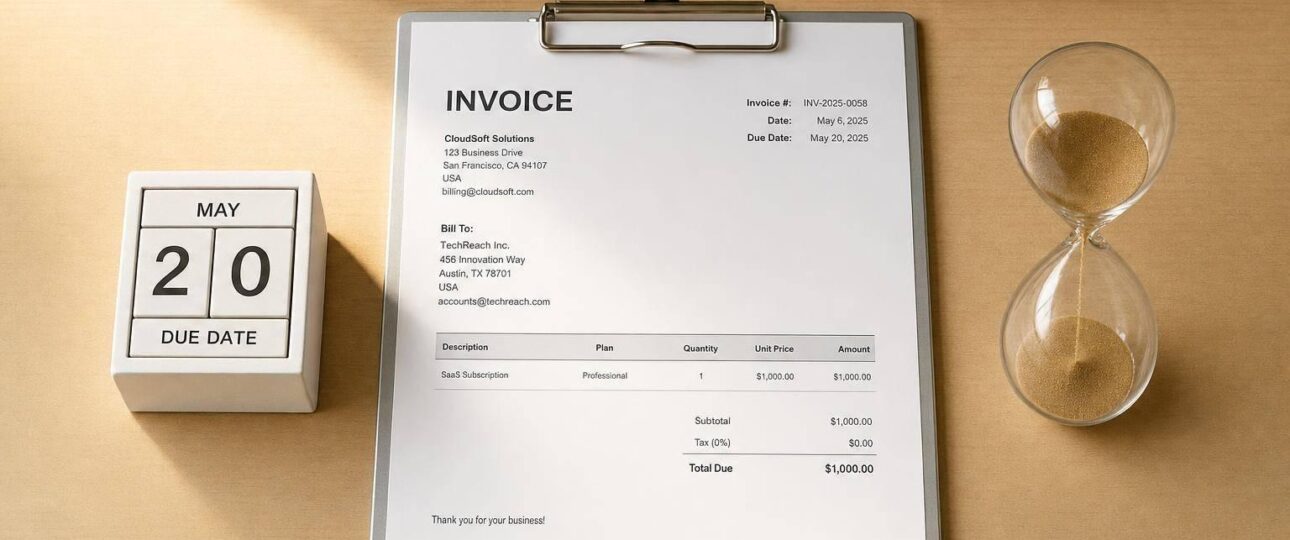
Bad payment language leads to disputes fast. In SaaS contracts, I look for five things first: when billing starts, when invoices go out, when payment is due, what happens if payment is late, and how plan changes, taxes, and refunds are handled.
Here’s the short version: most U.S. SaaS deals use Net 30, fixed subscription fees are often billed in advance, usage fees are often billed in arrears, and late-payment clauses usually follow a simple order: missed payment → written notice → cure period → late fee → suspension. The article also points out that Net 30 appears in 70% to 80% of U.S. B2B transactions, while Net 60 can increase bad-debt risk by 15% to 20%.
If I were reviewing a SaaS payment clause, I’d check these points right away:
- Pricing model: flat fee, tiered, usage-based, or hybrid
- Billing cycle: monthly, annual, or usage-based
- Billing start date: signing, activation, deployment, or another set milestone
- Invoice rule: at the start of the cycle or after usage closes
- Due date: Net 30, Net 45, Net 60, or a fixed calendar date
- Grace period and dispute window: often 5 to 10 days for cure, about 30 days for invoice disputes
- Payment methods: credit card, ACH, or wire
- Taxes and currency: fees listed in U.S. dollars, taxes handled by the customer unless stated otherwise
- Mid-term changes: prorated upgrades, later-effect downgrades, and overage charges
- Late-payment steps: interest, notice, suspension, and reinstatement terms
A short payment clause can still cover a lot. If these items are missing, you may end up arguing over money, timing, or service access later.
SaaS Pricing Models and Billing Cycles
The pricing model in a SaaS contract sets how charges are calculated, billed, and adjusted. After that, the contract needs to lock down three things: the pricing model, the billing cycle, and the billing start date.
Flat-Fee, Tiered, Usage-Based, and Hybrid Pricing
Flat-fee pricing means one fixed price for access to the service, no matter how much the customer uses it. That makes budgeting easier for buyers and gives sellers steady revenue.
Tiered pricing – such as Basic, Pro, or Enterprise – lets customers pay more as their needs grow. The contract should spell out what each tier includes so both sides know the scope of every plan.
Usage-based (metered) pricing charges based on actual consumption, like API calls, data storage, or compute hours. This model can work well, but usage spikes can lead to unexpectedly high charges [2][4][5]. That’s why it helps to require automated alerts when usage reaches 80% to 90% of the limit [2].
Hybrid pricing mixes a base fee with overage charges once usage goes past agreed limits. The contract should define both the trigger and the overage rate [2][4].
Once the pricing model is set, the contract should also say whether charges recur monthly, annually, or based on usage.
Monthly vs. Annual Billing and Advance vs. Arrears
Monthly billing is common for self-service and small business subscriptions. Annual billing usually requires upfront prepayment, often at a discount.
| Billing Model | Cash Flow Impact | Predictability | Billing Complexity |
|---|---|---|---|
| Monthly | Lower upfront cost; easier for SMB cash flow | Moderate; higher churn risk for seller | High; requires 12 invoices/collections per year |
| Annual | High upfront cost; often discounted | High; locked-in revenue for the term | Low; single invoice and payment per year |
| Usage-Based | Variable; paid in arrears based on consumption | Low; costs can balloon unexpectedly | High; requires constant metering and variable invoicing |
Annual prepayment leans in the seller’s favor because it improves cash flow and cuts down on collection work. Monthly billing, on the other hand, lowers the customer’s upfront cost. Fixed subscriptions – whether monthly or annual – are usually billed in advance. Usage-based fees and overages are usually billed in arrears [5].
When the Billing Period Starts
Even after the billing cadence is set, there’s still one practical issue left: when does billing actually begin? The contract should state whether billing starts on the signing date, account activation, deployment, or after a set implementation period [2][7].
A cleaner draft ties the billing start date to account activation or another specific milestone. That keeps the start point concrete instead of leaving it open to debate later.
sbb-itb-a688917
Invoices, Due Dates, and Net Payment Terms
Once the billing cycle is set, the contract still has to settle two plain questions: When does the invoice go out? And when is payment due? Miss either one, and disputes tend to show up fast. The next piece is invoice timing.
Invoice Timing and Billing Cadence
Invoice timing should flow from the billing start date already written into the contract. For fixed subscriptions, send the invoice at the start of the billing cycle. For usage-based plans, send it after the billing period ends. Put that rule in the contract so there’s no guessing later.
The date that starts the payment clock matters just as much as the due date. In most cases, that’s the invoice date. A simple line works well here: "Payment is due within 30 calendar days of the invoice date."
Net 30, Net 45, Net 60, and Fixed Due Dates
Net terms give the buyer a set number of days to pay after the invoice date. Net 30 is the most common starting point and appears in 70% to 80% of U.S. B2B transactions [8]. Net 45 and Net 60 show up more often in mid-market and enterprise deals, where approval cycles tend to take longer [12].
Here’s how those terms stack up for SaaS sellers and small business buyers:
| Term | Collection Timing | Cash-Flow Impact | Best Fit |
|---|---|---|---|
| Net 30 | 30 days from invoice date | Balanced; manageable for most sellers | Default for U.S. SMB buyers [8] |
| Net 45 | 45 days from invoice date | Moderate strain; seller carries costs longer | Mid-market or enterprise buyers with longer approval cycles |
| Net 60 | 60 days from invoice date | High risk; increases bad debt risk by 15% to 20% [8] | Larger enterprise buyers with strict billing cycles |
Some contracts use fixed calendar due dates instead, like "payment due on the 1st of each month." That can work just fine too. But the contract should also show the exact due date on every invoice, which cuts down on back-and-forth [13].
Grace Periods and Notice Before Enforcement
Many contracts give a five-business-day grace period before late fees or suspension kick in [12]. That buffer helps with routine payment delays, which happen all the time.
A notice-and-cure clause often gives the buyer 5 to 10 days to pay or dispute the invoice after written notice is received. In some enterprise agreements, that window stretches to 30 days before termination [11][6]. Contracts should also tell buyers how long they have to raise invoice disputes. A common window is 30 days, while any undisputed amount stays due on the original payment date [8][9].
The contract should also spell out accepted payment methods, currency, taxes, refunds, and credits.
Payment Methods, U.S. Currency, Taxes, and Mid-Term Adjustments
After invoice timing and grace periods, the contract should spell out how the customer pays and what happens when the deal changes mid-term.
Credit Card, ACH, Wire, and Other Accepted Payment Methods
Start by naming the payment methods you accept and what happens if a payment doesn’t go through. Credit cards are common for self-service and small-business subscriptions [4][1]. For larger enterprise deals, ACH and wire transfers are often the better fit because they cut transaction fees and lower chargeback risk [4][1].
The clause should also say whether failed payments lead to fees or retry charges.
| Payment Method | Processing Speed | Transaction Fees | Chargeback Risk | Typical Deal Size |
|---|---|---|---|---|
| Credit Card | Instant / Same day | High | High | Small / self-service |
| ACH Transfer | 3–5 business days | Low | Low | Mid-market / SMB |
| Wire Transfer | Same day / Next day | Fixed bank fee | Zero | Large enterprise |
U.S. Dollar Clauses and Tax Treatment
List all fees in U.S. dollars and use standard formatting like $1,500.00 [7]. The contract should also say that prices do not include sales, use, or similar taxes unless the customer gives a valid exemption certificate [7].
Put the tax burden where it belongs: the customer is responsible for taxes that apply in its jurisdiction [3]. If withholding is required by law, add a gross-up clause so the provider still receives the full amount due [7].
Refunds, Credits, Proration, and Overage Charges
This section should make the refund rules plain. In most cases, fees should be non-refundable once service starts unless the contract says otherwise [2]. Setup and implementation fees should also be non-refundable once work begins [2].
There is one common carveout in enterprise contracts: if the customer terminates for cause, the agreement may allow a pro-rata refund of prepaid fees [2][4].
If cash refunds aren’t available, credits are often the fallback. Instead of sending money back, apply the amount as an account credit to future invoices [4].
Plan changes in the middle of a billing cycle need clear rules too. Handle upgrades right away by billing the prorated price difference for the rest of the term. For downgrades, wait until the current cycle ends before the lower rate takes effect [14].
For usage-based plans, say how extra charges show up. A common approach is to bill overages as a separate line item after the usage period closes [2].
Late Fees, Suspension Rights, and Key Takeaways
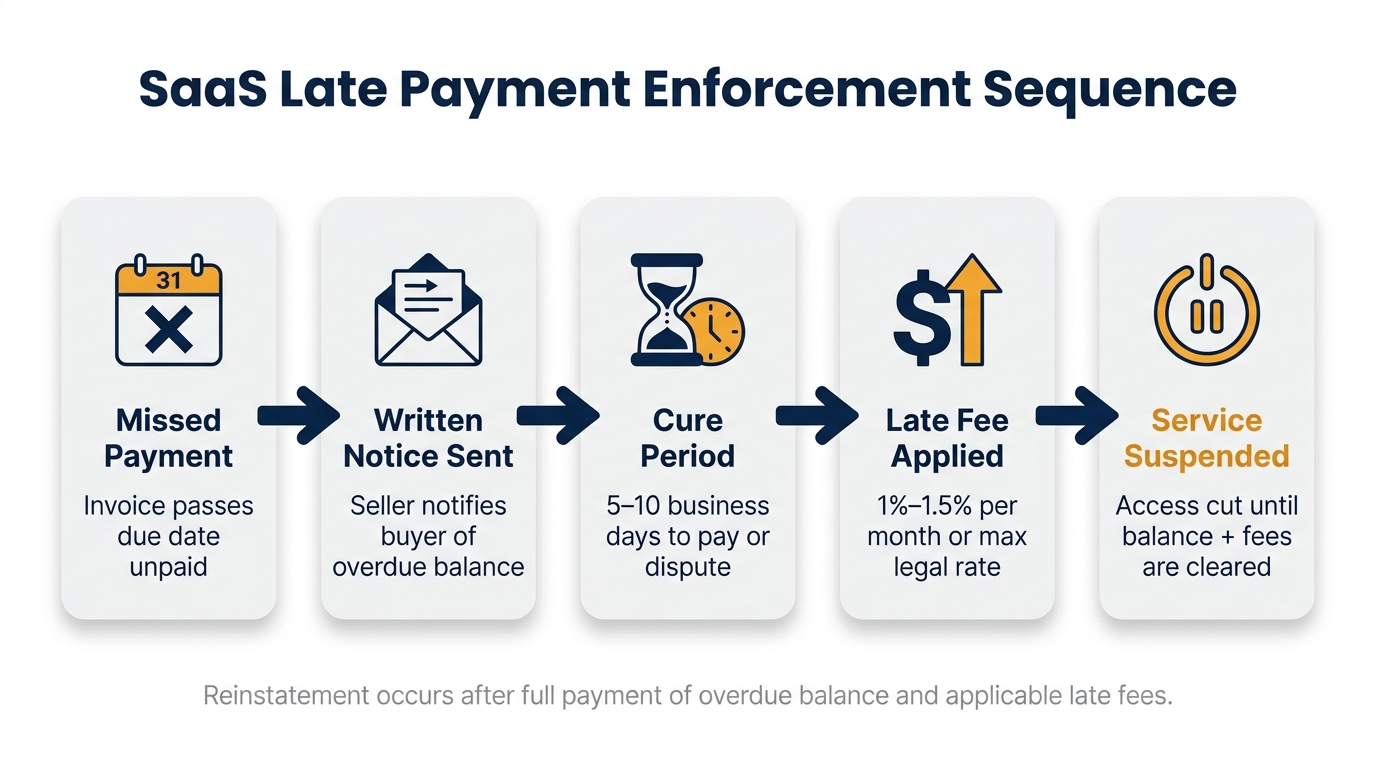
SaaS Late Payment Process: From Missed Payment to Suspension
Late Fees, Interest, and Service Suspension
Once invoice timing and payment deadlines are locked in, the contract should also say what happens if payment shows up late. If an invoice becomes overdue, the agreement may charge the lesser of 1% to 1.5% per month or the highest rate the law allows. Suspension shouldn’t happen on its own. It should come only after written notice [7][10].
The usual flow looks like this: a payment is missed, written notice is sent, late fees apply, and then service may be suspended if the unpaid balance still isn’t cleared. Buyers should push for written notice before any suspension, instead of agreeing to language that allows an immediate cutoff [7]. Reinstatement happens after the overdue amount and any late fees are paid [7].
Using Small Business Legal Documents to Draft Clearer Payment Clauses

Clear wording can cut down on fights over when suspension may begin. Small Business Legal Documents offers lawyer-reviewed templates that help businesses draft clearer payment clauses faster.
Key Takeaways for Reviewing SaaS Payment Terms
- Invoice timing and billing start date are defined
- Due dates and late-fee timing are stated clearly
- Notice and cure periods are separate from the due date
- Late fees, notice, and suspension follow a clear sequence
- Data export rights are included after termination
FAQs
What payment terms matter most in a SaaS contract?
The payment terms that matter most are billing cycles, payment due dates, and any usage-based overage charges.
Your contract should spell out whether billing happens monthly, quarterly, or annually. It should also say when payment is due after an invoice is sent, which is often under Net 30 terms.
It also helps to pin down the rest of the money details upfront, including:
- accepted payment methods
- the billing currency
- late fees
- grace periods before service suspension
- invoice dispute procedures
- auto-renewal notice periods
- any caps on renewal price increases
That may sound like fine print, but it can save you from a headache later.
Should SaaS fees be billed in advance or in arrears?
SaaS fees are usually billed in advance. That’s the standard setup for most SaaS companies because it helps vendors manage cash flow and keep service running without payment gaps.
Billing in arrears can be negotiated. Some customers prefer it because they want the service delivered before they pay.
The right option depends on your business model and what your customers expect. In most cases, though, advance billing is the norm for SaaS. Either way, the contract should clearly spell out the billing cycle and payment terms.
What should happen before service is suspended for nonpayment?
Before suspending service for nonpayment, the contract should spell out a clear grace period. In most cases, that means 30 days or more so service doesn’t get cut off right away.
The contract should also set a written dispute window, such as 15 days. That gives customers room to hold back payment on disputed invoices in good faith while both sides work toward a resolution.