
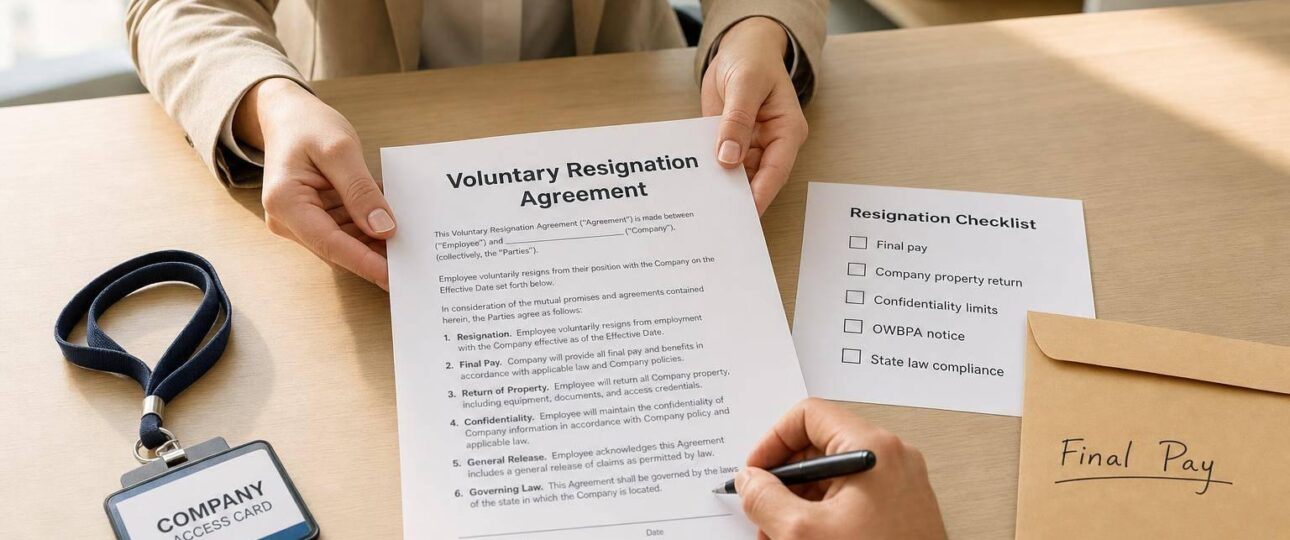
If you use a free resignation agreement template, I’d check 5 things first: voluntary language, final pay terms, property return, narrow confidentiality terms, and any age-40+ release rules.
A resignation agreement is not the same as a resignation letter. The letter is from the employee only. The agreement is signed by both sides and records what happens next, like the last workday, final wages, PTO, equipment return, and post-exit duties.
Here’s the short version:
- I’d use a resignation agreement when I want written proof that the employee left by choice.
- I’d keep final wages separate from any signature requirement.
- I’d only add a release of claims if the employee gets new pay or benefits, such as severance.
- If the employee is 40 or older, I’d check for the 21-day review period and 7-day revocation period under federal law.
- I’d also match the form to state rules on final pay, PTO payout, noncompetes, and venue.
Quick comparison
| Document | Who signs | Main job |
|---|---|---|
| Resignation letter | Employee only | Gives notice of quitting |
| Resignation agreement | Employee and employer | Confirms a voluntary exit and each side’s duties |
| Severance/separation agreement | Employee and employer | Trades pay or benefits for a release of claims |
One fact stands out: under OWBPA rules, an employee age 40+ may need 21 days to review a release and 7 days to revoke after signing. That alone is a good reason not to treat a free template like plug-and-play.
If I were using one, I’d treat it as a starting point – not the final draft.
sbb-itb-a688917
What to Include in a Free Voluntary Resignation Agreement Template
Use the template only if it includes the clauses that govern the exit.
Core Clauses to Review Before Using the Template
A good voluntary resignation agreement should start with the basics. That means the full legal names of both parties, the employee’s job title, the separation date, and the last day of active work. It should also state, in plain language, that the resignation is voluntary and that the employee is signing without pressure.
Final compensation needs to spell out what will be paid. Include earned wages, unpaid commissions or bonuses, and accrued PTO or vacation. If benefits will continue, list COBRA or state continuation deadlines and any employer subsidy [7][6]. State law controls when final pay must be made, so the check should not be held back until the employee signs [7].
The return-of-property clause also deserves a close look. The agreement should name the items that must come back, such as:
- Laptops
- Mobile devices
- Key cards
- Badges
- Credit cards
- Proprietary documents or data
It should also set a clear return deadline [3][6][5].
For confidentiality, keep the wording narrow. Focus on trade secrets and specific business data. Following the 2023 McLaren Macomb NLRB ruling, broad confidentiality or nondisparagement terms are restricted for non-supervisory employees [5]. The template should include carve-outs that protect the employee’s right to file EEOC or NLRB charges and to seek unemployment benefits or workers’ compensation [7][5]. Put simply, a voluntary resignation agreement should record the exit without adding broad restrictions that create legal risk.
If the template includes a release of claims, it must also include consideration and, when needed, OWBPA terms for workers age 40 or older. A valid release requires new consideration, such as severance pay or extra benefits [6][5]. Final wages and accrued PTO do not count because the employer already owes them [5][6].
For employees age 40 or older, the Older Workers Benefit Protection Act (OWBPA) adds a few rules. The agreement must refer to the Age Discrimination in Employment Act (ADEA), give the employee 21 days to review the agreement, or 45 days for group terminations, and include a 7-day revocation period after signing [1][4][5]. It should also advise the employee in writing to consult an attorney before signing [7][5]. The release does not take effect until that 7-day revocation period ends [5][4].
Once those clauses are set, update the dates, pay terms, and release language to match federal and state rules.
Resignation Letter vs. Resignation Agreement vs. Severance Agreement
These documents do different jobs, and mixing them up can leave holes in your files or create legal risk. A resignation agreement works best as a mutual record of the exit. A severance agreement should be used only when pay or benefits are being exchanged for a release.
How to Customize the Template for U.S. and State Law
After you confirm the core clauses, the next step is to fit the template to the employee’s state and to any release terms.
Update Dates, Pay Terms, and State-Specific Rules
Before anyone signs, line up the template with the employee, the role, and the state law that controls the Agreement. Every placeholder needs to be replaced with actual details. Write dates in full U.S. style, such as July 13, 2026, and format payment amounts in U.S. dollars, like $2,500.00.
You’ll also want to confirm the last working day and the notice period. Then check the state rule for the final paycheck. In Texas, for example, final wages after discharge must be paid no later than the sixth calendar day. If the employee resigns, payment is due on the next regular payday instead [7]. That rule applies whether or not the employee has signed anything.
PTO is another area where people get tripped up. Before you list accrued vacation as consideration, check the state rule on PTO payout.
Noncompete terms need the same kind of care. California has effectively banned most noncompetes, while Illinois limits them for employees making under $75,000 per year [6]. Massachusetts goes a step further and requires continued pay during the noncompete period [6]. So the noncompete clause should be narrowed, changed, or removed based on the state where the employee worked.
Once the dates and payment terms are set, turn to the release language and make sure it can hold up.
Add Release Language Carefully When Claims Are Involved
If the Agreement includes a release of claims, spell out the statutes being released. That may include claims under the Age Discrimination in Employment Act (ADEA) or the state human rights law that applies. At the same time, include clear carve-outs for rights the employee cannot waive, such as the right to file an EEOC charge, seek unemployment benefits, or pursue workers’ compensation [5][7].
After that, compare the stock template language with a version written for the actual facts before signing.
Default Template Wording vs. Customized Legal Wording
Default language often sounds fine on paper but falls apart in a real exit. Here’s how generic wording changes when you fit it to an actual state and business context.
| Clause | Default Template Wording | Customized Legal Wording |
|---|---|---|
| Governing Law | "This agreement is governed by applicable state law." | "This Agreement is governed by the laws of the State of Texas; disputes shall be brought in Harris County." [7] |
| Non-Compete | "Employee shall not compete with the Company for one year." | "Employee shall not compete within 50 miles of [City] for 12 months, as allowed by applicable law." [7] |
| Release of Claims | "Employee releases all claims against the Employer." | "Employee releases all claims, including those under the Texas Commission on Human Rights Act (TCHRA) and ADEA." [7] |
| Review Period | "Employee has 21 days to review this Agreement." | "Employee has 21 days to consider this Agreement and 7 days to revoke after signing (OWBPA compliant)." [5][7] |
| Payment Terms | "Severance will be paid upon signing." | "Severance of $2,500.00 will be paid in a lump sum after the revocation period ends." [2][5] |
Step-by-Step Process to Use the Agreement at Employee Exit
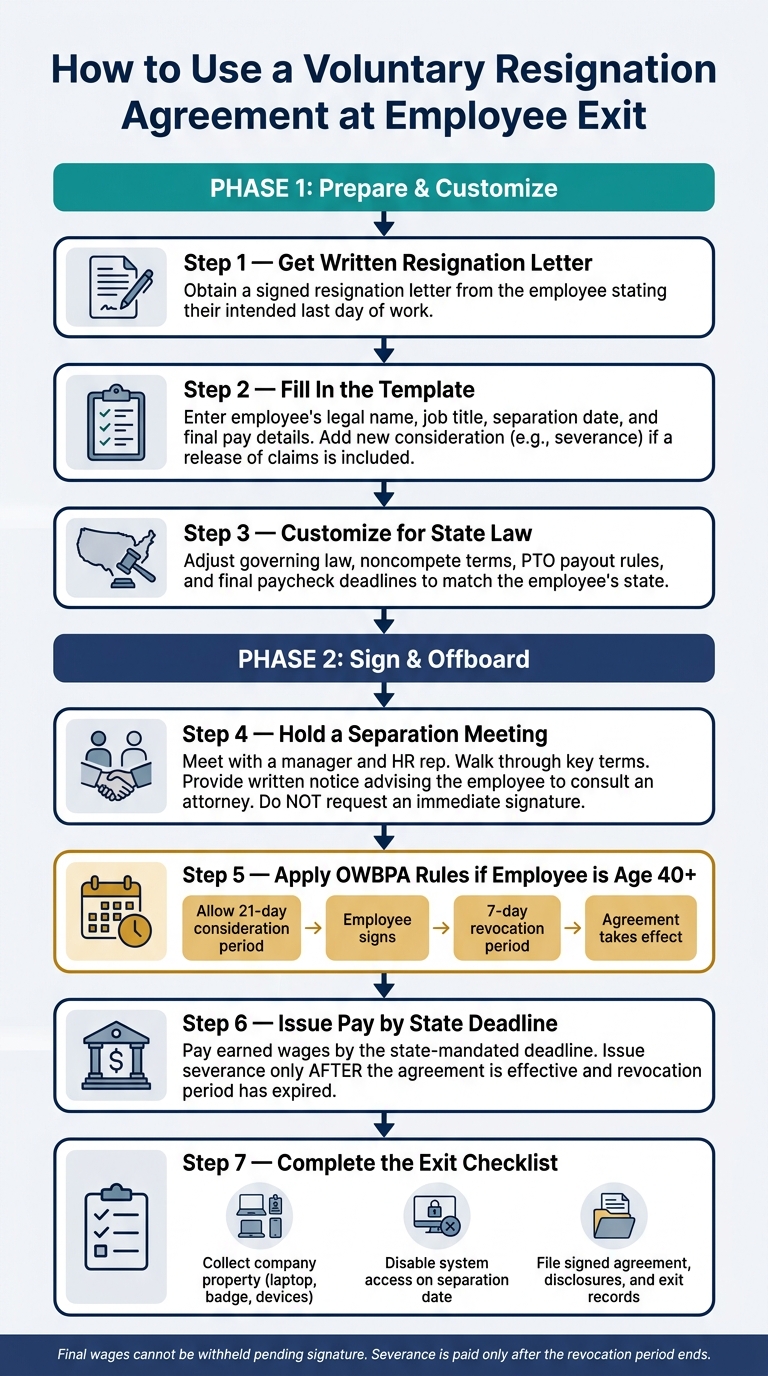
Step-by-Step Process to Use a Voluntary Resignation Agreement
After you customize the template, stick to the same workflow for each voluntary resignation.
Prepare the Documents and Confirm the Resignation
First, get a written resignation letter from the employee that clearly states the intended last day of work.
Next, fill in the template with the employee’s legal name, job title, separation date, and final pay details. If the agreement includes a release, add new consideration, such as severance [5][6].
Once the resignation is confirmed, move to the signing meeting and the rest of the offboarding steps.
Review, Sign, and Complete the Exit Checklist
Set up a short separation meeting with a manager and an HR representative present. Share the agreement, walk through the main terms, and give the employee written notice to consult an attorney before signing. Do not ask for an immediate signature [5][6].
For employees age 40 or older, federal law under the OWBPA requires:
- a 21-day consideration period
- a 7-day revocation period after signing
The agreement takes effect only after the 7-day revocation period ends [5][2].
Pay earned wages by the state deadline. Issue severance only after the agreement is effective and any revocation period has expired [5][7].
After both sides sign and date the agreement, give each party a copy. Then finish the exit checklist:
- collect company property
- disable system access on the separation date
- file the signed agreement, required disclosures, and exit records [3][6]
Using Small Business Legal Documents and Final Takeaways

How Small Business Legal Documents Helps with Customization
After each exit, update the template so it’s set for the next resignation.
Small Business Legal Documents offers lawyer-reviewed templates, including employment and termination-related documents [8]. Its customization tool lets you plug in party names and other key details, and the document fills in automatically. You also get a state-law selector plus editable fields for party names, pay terms, restrictive covenants, and release language.
Key Points Before You Use a Free Template
A resignation agreement only works if the details are correct. Before anyone signs, check these five points:
- The resignation is clearly voluntary.
- The last day of employment is stated.
- Property return and confidentiality are covered.
- Final pay is separate from any signature requirement.
- Any release has new consideration, such as severance pay, and OWBPA-compliant language for employees age 40 or older.
Careful customization and steady offboarding help cut disputes and legal risk.
FAQs
Do I need both a resignation letter and a resignation agreement?
Not necessarily. A resignation letter is a formal notice from the employee. A resignation agreement, on the other hand, is a binding contract between the employer and the employee.
In plain English: one says, “I’m leaving.” The other spells out the terms of that departure.
You usually need a resignation agreement only when the employer is offering severance pay or some other consideration beyond earned wages. If the employee is simply leaving and there’s no severance involved, a standard resignation letter is usually enough.
Can I require an employee to sign before releasing final pay?
No. You can’t make an employee sign a resignation agreement or release of claims just to get final pay they already earned.
That money is still owed, whether they sign or not. This includes final wages, accrued vacation, and any other compensation the law requires you to pay.
If you want a release of claims to hold up, the employee has to get consideration in return. In plain English, that means something extra, like severance pay they wouldn’t otherwise receive.
When does OWBPA apply to a resignation agreement?
OWBPA applies when a resignation agreement includes a release of age-discrimination claims for an employee who is 40 or older.
For that waiver to hold up, the agreement needs to meet a few specific rules. It must use plain language, clearly mention the ADEA, provide extra consideration, advise the employee in writing to consult an attorney, allow 21 days to review it – or 45 days in group terminations – and give the employee 7 days to revoke after signing.