
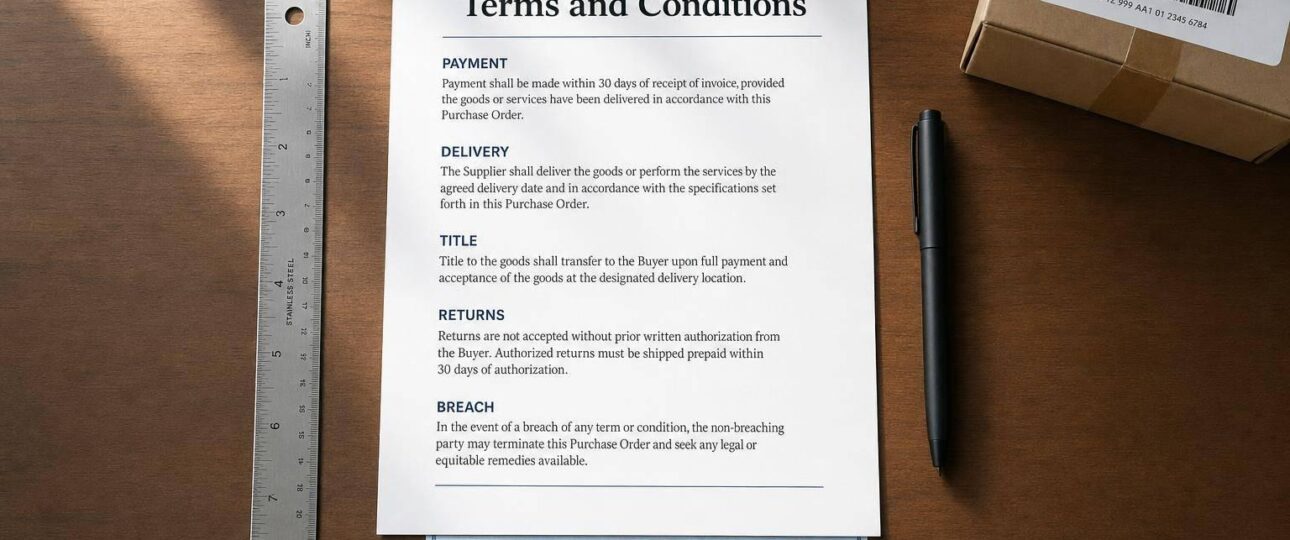
A purchase order can decide who pays, who takes the loss, and how a dispute gets fixed. In the article, I see three big risk areas: payment and delivery, damage and returns, and breach and replacement buying. If a PO leaves those points vague, even a $14,000 shipment or a batch with 30% damaged units can turn into an argument fast.
Here’s the short version:
- I’d make the payment clock start only after a correct and complete invoice
- I’d set a hard delivery date and say time is of the essence
- I’d give the buyer 10 business days to inspect and reject non-conforming goods
- I’d state when title passes and who holds risk of loss during transit
- I’d spell out who pays return shipping for defective goods
- I’d add a breach process with written notice, a 15-business-day cure period, termination rights, and cover damages
The main point: one clear PO template can cut down fights before they start. That matters because under U.S. sales law, a vendor may try to add different terms through its own form, and vague wording can leave both sides arguing over default rules instead of the deal they thought they had.
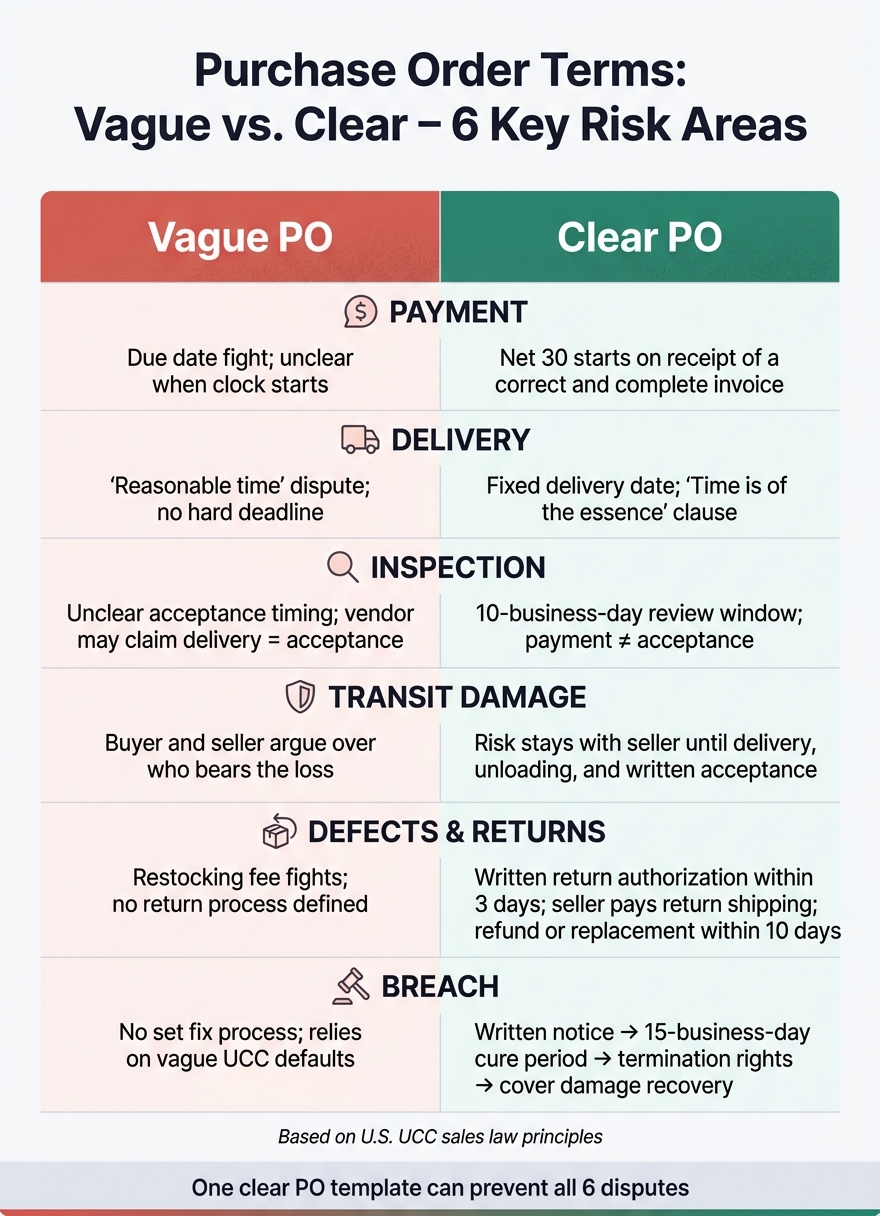
Purchase Order Terms: Vague vs. Clear – Key Risk Areas Compared
Simplifying Purchase Order Terms and Conditions
sbb-itb-a688917
Quick comparison
| Issue | If the PO is vague | If the PO is clear |
|---|---|---|
| Payment | Due date fight | Net 30 starts on receipt of a proper invoice |
| Delivery | “Reasonable time” dispute | Fixed date with late-delivery leverage |
| Inspection | Unclear acceptance timing | 10-business-day review window |
| Transit damage | Buyer and seller argue over loss | Risk stays with the named party until a stated event |
| Defects and returns | Restocking fee or delay fight | Written return, shipping, refund, or replacement rules |
| Breach | No set fix process | Notice, cure, termination, and cover rights |
So if you want a plain-English takeaway, it’s this: put the hard rules in writing before the order goes out, and keep the legal terms the same across every PO.
Case study 1: Payment and delivery terms that reduce confusion
Payment and delivery terms are where most PO disputes begin. That’s why clear wording matters.
Payment terms example: invoice timing, Net 30, and disputed charges
ABC Manufacturing ran into a payment dispute because its PO didn’t say when payment was due. The supplier expected payment in 15 days. ABC, on the other hand, paid on a 30-day cycle.
Sample clause:
All invoices shall be submitted only after full delivery of the goods described in this Purchase Order. Payment is due net 30 days from Buyer’s receipt of a correct and complete invoice. Buyer may withhold payment of any specific charges disputed in good faith, without penalty or late fees, until the dispute is resolved. Payment of undisputed amounts shall not be delayed.
That phrase – correct and complete invoice – does a lot of work. It makes clear that the payment clock starts only when the invoice is accurate, not just when one is sent over.
Shipping and inspection example: freight costs, late delivery, and acceptance
Shipping terms can cause the same kind of mess. If the PO doesn’t say who pays freight, when delivery is due, or how long the buyer has to inspect the shipment, the vendor may still argue that delivery was complete.
Sample clause:
Seller shall ship the goods by the required carrier to Buyer’s specified location no later than [specific date]. Time is of the essence. Buyer shall have 10 business days from receipt to inspect the goods. Payment of an invoice shall not constitute acceptance of goods. Buyer may reject non-conforming goods within the inspection period, even if payment has already been made.
The phrase time is of the essence matters because, without it, the legal default is delivery within a commercially reasonable time. [3]
Once delivery terms are clear, the next dispute usually comes down to who bears the loss if goods are damaged in transit.
Case study 2: Title transfer, risk of loss, and returns
Title and risk of loss example: goods damaged in transit
Imagine Riverside Fixtures, a mid-size retail chain, orders $14,000 in display shelving from a supplier in Ohio. The shipment shows up, and 30% of the units are crushed. The PO doesn’t say anything about shipping terms or who eats the loss if goods are damaged in transit. The supplier says it gave the carrier goods in perfect condition. Riverside says the damage happened before the shipment reached its dock. Now both sides are stuck.
That’s where title and risk of loss start to matter. Title is ownership. Risk of loss is who pays if the goods are lost or damaged. Those two things don’t always move at the same moment.[1]
Sample clause:
Title to the goods shall pass to Buyer upon Buyer’s written acceptance following inspection at Buyer’s receiving dock. Risk of loss shall remain with Seller until the goods are delivered to Buyer’s dock and unloaded.
FOB Destination often means the seller keeps the risk until the goods reach the buyer’s dock. But the clause above is more exact. It ties title and risk to clear events: delivery, unloading, and acceptance.[1]
| Feature | FOB Shipping Point (Risk at Carrier Handoff) | FOB Destination (Risk at Buyer Receipt) |
|---|---|---|
| Primary risk holder | Buyer | Seller |
| Insurance responsibility | Buyer typically insures goods in transit | Seller typically insures goods in transit |
| Dispute likelihood | Higher – buyer may need to resolve transit damage with the carrier | Lower – buyer can reject damaged delivery at the dock |
| Recordkeeping | Requires proof of handoff to carrier | Requires proof of delivery or receipt signature |
If a shipment arrives damaged or defective, the next fight is usually about returns: how the buyer rejects the goods, who pays to send them back, and when money or replacements show up.
Returns and rejection example: defective goods and refund timing
The same basic problem shows up here too: who pays when the goods don’t arrive in usable condition. Take Clearwater Office Supply, a small business in Texas, receiving 500 ergonomic chairs from a vendor. Forty chairs have cracked armrests. The PO says nothing about returns, inspection timing, or who pays shipping on defective goods. The vendor offers a restocking fee. Clearwater expected the refund or replacement process to be written down, not argued over after the fact.
Under UCC § 2-601, the buyer can reject the whole shipment, accept all of it, or accept the conforming units and reject the rest.[1] But if the PO doesn’t spell out the process, that right can turn into a back-and-forth instead of a clean fix.
Sample clause:
Buyer shall have 10 business days from receipt to inspect the goods and notify Seller in writing of any defects or non-conformities. Buyer may reject all goods, accept all goods, or accept conforming units and reject the rest. Seller shall issue a return authorization within 3 business days of Buyer’s notice. Return shipping costs for defective or non-conforming goods shall be borne by Seller. Seller shall, at Buyer’s choice, provide a full refund, replacement goods, or a credit memo within 10 business days after receiving the returned goods.
A set inspection window helps avoid fights over what counts as a reasonable time.[2]
| Feature | Strict Return Policy | Buyer-Friendly Defect Policy |
|---|---|---|
| Legal protection | Favors seller; short notice periods | Favors buyer; allows time for defect discovery |
| Operational burden | High for buyer – requires immediate, careful inspection | High for seller – must manage returns and replacements |
| Vendor relationship impact | Can be adversarial; limits buyer remedies | Clear expectations reduce disputes and build accountability |
If the seller won’t cure, refund, or replace the goods, the issue shifts from returns into breach territory.
Case study 3: Breach, termination, and cover purchases
Breach handling example: notice, cure period, termination, and replacement buying
When late deliveries or repeat spec failures keep happening, the issue stops being a simple rejection problem and becomes a breach. At that point, the buyer needs a clear written process for notice, cure, termination, and replacement buying.
This hits small businesses hard. Picture a company that depends on a recurring PO for packaging materials. The seller keeps shipping late and keeps sending goods that miss the specs. If the PO doesn’t spell out a breach process, the buyer has no set deadline for a fix and no clean line for ending the relationship and buying from someone else. Then the buyer scrambles to find replacement materials at a higher price and has little power to get that extra cost back.
Sample clause:
Time is of the essence with respect to all delivery dates stated in this Purchase Order. Late delivery or two spec failures in any rolling 90-day period shall constitute a material breach of this Purchase Order. Buyer shall provide written notice of breach to Seller. Seller shall have 15 business days from receipt of such notice to cure the breach. If Seller fails to cure within that period, Buyer may terminate this Purchase Order for cause and buy substitute goods elsewhere, so production keeps moving. Seller shall be liable for the difference between the original PO price and the replacement price, provided Buyer acts promptly in making the cover purchase.
| Feature | PO with No Stated Remedies | PO with Clear Cure, Termination, and Cover Rights |
|---|---|---|
| Leverage | Low; relies on vague "reasonable" standards under the UCC | High; specific breach triggers give the buyer a clear enforcement path |
| Dispute Cost | High; often requires legal intervention to define "materiality" | Lower; terms are pre-defined, reducing litigation over definitions |
| Business Continuity | Risky; no contractual right to buy elsewhere and charge back the cost | Strong; cover rights allow rapid replacement of critical inputs |
| Response Time | Slow; vendor may delay fixes without a contractual deadline | Faster; vendor is under a cure clock and faces termination if they miss it |
| Financial Recovery | Difficult to recover the premium paid for replacement goods | Clear right to recover the price difference on cover purchases |
How the clause would have changed the outcome
With this language in place from day one, the second late shipment would have triggered a written notice sent by certified mail or tracked courier [4]. From there, the seller would have 15 business days to cure the breach. Miss that window, and the buyer could terminate for cause, buy packaging from another supplier, and recover the gap between the original PO price and the replacement price.
The practical point is simple: put these terms into one standard PO so every order follows the same breach rules.
Putting the clauses into one workable PO template
How to keep clauses consistent across every purchase order
These clauses only work when they work together. If one clause conflicts with another, you’re back in the same mess that showed up in the case studies.
The point here is simple: make the sample clauses fit into one PO template that holds up when a deal goes sideways.
Here are the mismatches to watch for:
- Align delivery terms with risk-of-loss language.
- Inspection windows must come before payment.
- Return deadlines must align with inspection periods.
A good rule is to use one approved master template and change only the deal-specific fields, like quantity, unit price, delivery address, and delivery date. Keep the legal terms fixed. That includes a sentence saying acceptance is limited to the PO’s terms, so vendor-added language doesn’t wipe out your protections.
Once the template is lined up, leave it alone across every order except for those deal-specific fields.
Small Business Legal Documents offers customizable, lawyer-reviewed purchase order templates.
Conclusion: The clauses that matter most in a U.S. purchase order
Payment, shipping, title, returns, and breach clauses each handle a different problem. And plain-language drafting is what makes them usable when things get tense. For small businesses, that kind of clarity helps protect cash flow and keeps operations moving.
FAQs
Can a supplier override my PO terms?
Usually, no. A supplier generally can’t change your Purchase Order on its own. But the answer turns on how the contract was formed.
Under the UCC in most U.S. states, a supplier’s acknowledgment that includes terms different from yours can trigger a "battle of the forms."
That means a contract may still exist even when the two sets of terms don’t match. In that case, the conflicting terms are often knocked out and replaced by UCC default rules unless the supplier’s acceptance is expressly conditional on your terms.
To help avoid that mess, your PO should say that:
- any conflicting or added supplier terms are rejected
- your terms control
That kind of language won’t solve every dispute, but it puts your position in much better shape from the start.
Should title and risk of loss pass at the same time?
Not necessarily. People often set title and risk of loss together with terms like FOB so the handoff point is plain.
But they don’t have to move at the same time. Your purchase order can say that, even with the FOB point in place, the seller keeps the risk of loss until final inspection and acceptance at the buyer’s location.
What happens if I accept some goods and reject the rest?
You can usually accept part of a shipment and reject the rest if the rejected items are defective or don’t match the order.
Any goods you reject can be sent back to the supplier at the supplier’s risk and expense. You can choose the remedy that fits the situation:
- credit
- replacement
- refund
Also, paying for the goods – or accepting part of the shipment – does not usually mean you’ve given up your right to reject goods that don’t conform. It also doesn’t cancel the supplier’s duty to meet the order specifications.