

The right template is the one that matches how money, work, and control are split. If you pick the wrong type, many states may fall back to default partnership rules that often treat partners as equal on profits and management.
Here’s the short version:
- I’d use an equal partner template for a 50/50 setup with shared control
- I’d use a silent partner template when one person funds the business and the other runs it
- I’d use a working partner template when both partners work, but not at the same level
- I’d use a family-run template when succession, inactive relatives, and buy-sell rules matter as much as day-to-day work
No matter the type, I’d check these points first:
- Capital contributions: cash, property, or sweat equity
- Profit and loss split: not just ownership on paper
- Decision rules: daily decisions vs. major decisions
- Pay terms: draws, guaranteed payments, or both
- Exit terms: death, disability, retirement, or partner withdrawal
- State law: the agreement should match the law of the state that governs it
One point stands out: a 50/50 agreement can stall the business if there’s no tie-breaker, and a silent partner deal can go sideways if control and reporting are vague. In family firms, the weak spot is often not ownership – it’s unclear authority and poor transfer rules.
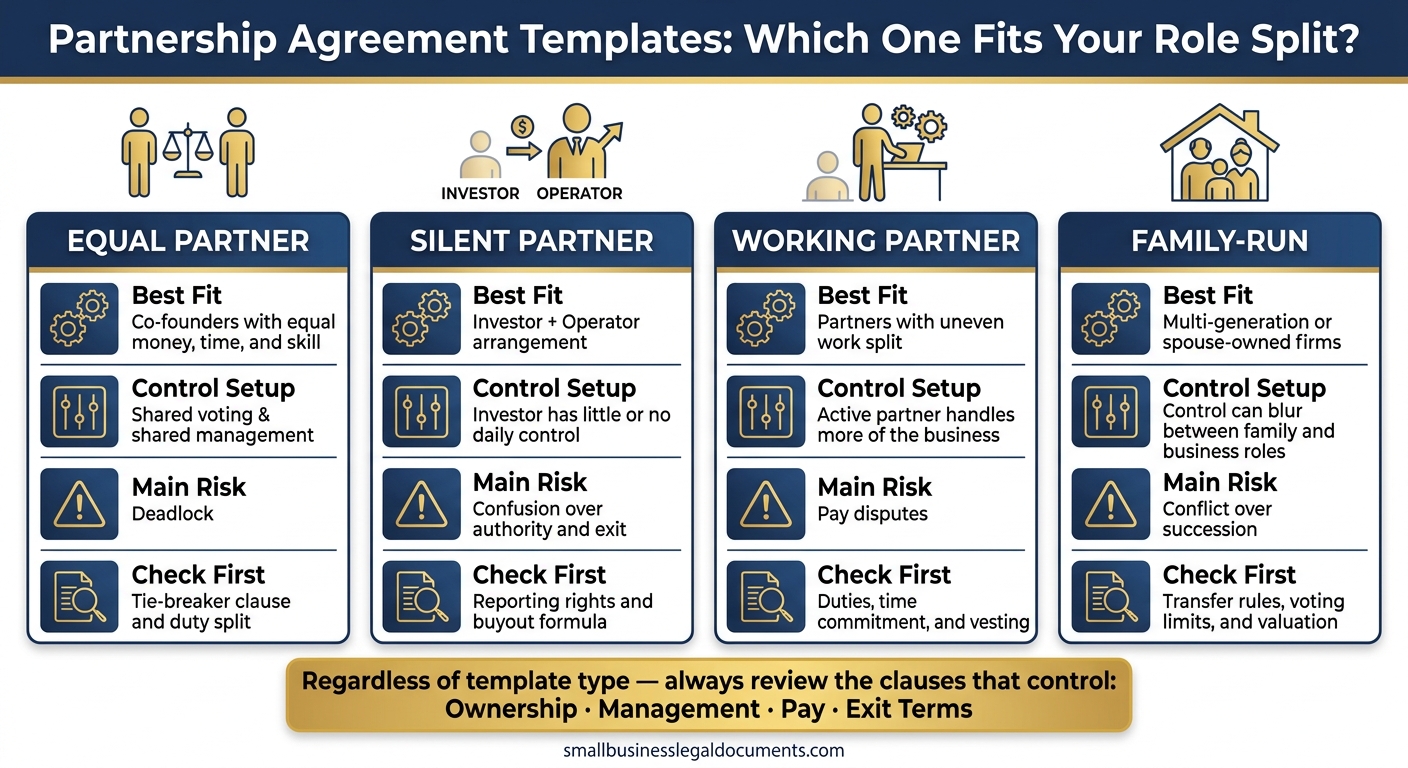
Partnership Agreement Templates: Which One Fits Your Role Split?
How to Structure a Successful 50 50 Business Partnership Agreement
sbb-itb-a688917
Quick Comparison
| Template | Best Fit | Main Control Setup | Main Risk | What I’d check first |
|---|---|---|---|---|
| Equal Partner | Co-founders with near-equal money, time, and skill | Shared voting and shared management | Deadlock | Tie-breaker and duty split |
| Silent Partner | Investor + operator | Investor has little or no daily control | Confusion over authority and exit | Reporting rights and buyout formula |
| Working Partner | Uneven work split | Active partner handles more of the business | Pay disputes | Duties, time commitment, and vesting |
| Family-Run | Multi-generation or spouse-owned firms | Control can blur between family and business roles | Conflict over succession | Transfer rules, voting limits, and valuation |
If I were choosing fast, I’d ignore the template name and read the clauses that control ownership, management, pay, and exit. That’s what tells you whether the document fits the way the partnership will work on 7/17/2026 and after.
4 Partnership Agreement Templates by Role Split
Equal Partner Template: Shared Ownership and Shared Decisions
This template works best when two or more co-founders put in about the same level of money, time, and skill. It usually starts with a 50/50 split of profits, losses, and management authority [4]. That makes it easy to draft and simple to follow.
The main problem is deadlock. If both partners have the same vote, one disagreement can bring the business to a halt. A tie-breaker clause helps. That could mean a 51/49 split, or bringing in an outside mediator or arbitrator when partners can’t agree [7]. It also helps to spell out each partner’s duties so no one ends up arguing over who’s doing more work.
If one person is putting in the cash and the other is running the company, a silent partner template is usually a better fit.
| Advantage | Drawback |
|---|---|
| Simplicity: Easy to draft and follow. | Deadlock Risk: 50/50 splits can paralyze decisions [7]. |
| Alignment: Both co-founders stay equally committed. | Effort Imbalance: Risk of resentment if one partner contributes more [7]. |
| Liability: Each partner remains exposed to partnership liabilities. |
Silent Partner Template: Investor and Operator Arrangements
A silent partner template fits when one person funds the business and another runs it. The investor puts in capital – often most of the startup cash – but does not have day-to-day management authority [1][5]. This setup is often structured as a limited partnership (LP), which separates the investor from daily operations [5][3].
The agreement should clearly state:
- The amount of the capital contribution
- The silent partner’s share of profits
- What reporting access they get, including the right to review financial statements [4]
- Transfer limits and the buyout formula, so both sides know how an exit will work
This kind of split is pretty common. One partner backs the business financially. The other is in the trenches, handling the day-to-day work. The contract needs to match that reality.
| Feature | Silent Partner (Investor) | Working Partner (Operator) |
|---|---|---|
| Control | Limited or no management rights [1][5] | Full day-to-day management authority [2] |
| Financial Contribution | Primary source of initial capital [4] | Often contributes sweat equity or expertise [4] |
| Exit Rights | Tied to return or a specific buyout formula [4] | Subject to vesting and non-compete clauses [7][8] |
| Reporting | Right to review financial statements [4] | Responsible for maintaining books and records |
If both partners work in the business, but not to the same degree, the next template makes more sense.
Working Partner and Family-Run Templates: Active Roles and Shared Relationships
A working partner template is a good fit when partners put in different amounts of time, such as one person working full-time and another part-time [2]. In that setup, the details matter. The agreement should cover how compensation works, whether that means salary-like payments, distributions, or both. It should also define duties, time expectations, and non-compete terms.
For ownership, a 4-year vesting schedule with a 1-year cliff is a common way to tie equity to long-term commitment [7]. And one tax point matters here: partnership compensation is paid as a guaranteed payment reported on Schedule K-1, not W-2 wages [2].
Family-run businesses need a different focus. Here, the issue often isn’t just workload. It’s succession, ownership transfer, and the fact that family ties can blur authority. The agreement should separate active and inactive roles. It should also cover succession rules, voting limits for inactive family members, and buy-sell terms for retirement, death, or exit.
The valuation method should be picked ahead of time. That might be book value, an earnings multiple, or an independent appraisal [7][5]. Doing this up front can save a lot of conflict later.
Use the table below to compare how these two templates handle control, pay, ownership, and exit terms.
| Feature | Working Partner Template | Family-Run Template |
|---|---|---|
| Primary Focus | Time commitments and compensation for labor [2] | Succession planning and relationship boundaries [7] |
| Best For | Professionals with different workloads [2] | Multi-generational firms or spouse-owned businesses [5] |
| Key Clauses | Detailed duties and time expectations [2] | Buy-sell terms and voting limits for non-active members [7] |
| Compensation | Salary-like payments + distributions | May involve unequal draws based on need [5] |
| Exit Strategy | Buy-sell based on market value | Often involves internal transfer to heirs [7] |
How to Compare Templates Before You Choose One
Don’t get hung up on the template name. Read the actual clauses. That’s where you’ll see who controls the business, how money gets paid out, who owns what, and whether the setup fits how you plan to work together.
Compare Control, Pay, and Ownership Terms Side by Side
| Template Type | Management Rights | Ownership Terms | Pay Terms | Best-Use Scenario |
|---|---|---|---|---|
| Equal Partner (50/50) | Shared control; needs a deadlock rule. [6] | Strictly 50/50 split of equity and assets [6] | Equal draws and profit distributions [6] | Co-founders with identical stakes and trust [6] |
| Silent Partner (LP) | General Partner manages; Limited Partner has no say [1][4] | GP has control; LP equity capped at investment [4] | Fixed return or priority payout [4] | Real estate or ventures with outside investors [10] |
| Working Partner | Active day-to-day management [7] | Often uses vesting for work-based equity [7] | Guaranteed payments plus profit share [6] | One partner provides cash, the other provides labor [4] |
| Family-Run | Shared control; authority may be informal [5] | Can be unequal based on contribution [5][9] | Typically draws based on percentage interest; may include tax draws [4][9] | Small businesses transitioning between generations [5] |
As you compare templates, focus on the parts that affect daily life in the business. Who can sign contracts? How are profits split? Do major decisions need both partners to approve them? Those details matter a lot more than the title at the top of the document.
Then take one more step: make sure the template lines up with your state law and your exit terms.
Check State Law Language and Exit Provisions
Once control and pay look right, review the governing law and exit language. The template should match the law of the state that governs the deal. A generic form doesn’t automatically wipe out default rules that clash with your setup, so the agreement needs to name the governing state law and clearly replace default rules that don’t fit your role split [10][12][8].
Exit terms need the same level of care as ownership terms. Cover withdrawal, death, disability, bankruptcy, and expulsion, along with notice rules and valuation terms [4][7]. It’s smart to settle the valuation method now – before there’s stress or bad blood. That can mean book value, an earnings-based formula, an independent appraisal, or a fixed agreed value updated each year [7][9][11].
After that, you can move on to the tools that let you tailor those terms.
Using Small Business Legal Documents to Customize a Role-Split Template

Once you’ve chosen the right role split, the next move is simple: edit the clauses that govern ownership, management, pay, and exit terms.
That’s where Small Business Legal Documents comes in. If the template already lines up with the role split, you’re not starting from scratch. You’re taking a draft that fits the deal and shaping the details around how the partnership will actually work.
Templates and Customization Features That Matter for Partnerships
Small Business Legal Documents offers 2,000+ lawyer-reviewed templates, with options that fit equal partners, silent partners, working partners, and family-run firms.
Its customization tool lets you:
- Set ownership percentages
- Define capital contributions in dollars
- Assign management authority
- Choose the governing state law
That matters because you can match the agreement to both your role split and your state law instead of falling back on RUPA defaults. Those defaults can otherwise push you into equal profit splits and shared management rights, even when that’s not what the partners intended.
You can also spell out who gets to approve day-to-day decisions and who has to sign off on major ones. In a 50/50 setup, you can add a shotgun buy-sell clause to help deal with deadlock if the partners hit an impasse [6].
Membership Plans for Businesses That Need Ongoing Document Access
If you expect to revise documents later, access can matter just as much as customization.
| Plan | Price | Access Period | Best For |
|---|---|---|---|
| Unlimited Membership | $99/year | Annual | Businesses that need ongoing edits |
| Lifetime Membership | $149 one-time | Permanent | Businesses that want one-time, long-term access |
Conclusion: Match the Template to Your Actual Partnership Structure
After looking at control, pay, and exit terms, make the final call based on how the partnership runs day to day. The right partnership agreement template should match the way the business works in practice. That means looking at who puts in capital, who runs the business, who holds control, and how profits are divided. Equal partners, silent partners, working partners, and family-run firms don’t all fit the same setup, so the format should match the actual arrangement.
Without a written agreement, many states default to RUPA, which often leaves profits and management split equally [4]. If the agreement will last longer than one year, some states, including Florida, require a signed writing for enforcement [13]. That legal starting point makes the choice more than a paperwork issue. It means the template should fit the business model, not just the label.
Match the template to the real roles, then adjust the terms so the agreement lines up with how the partnership actually operates.
FAQs
How do I choose the right partnership template?
Choose a template that fits your business structure, how you want to run the company, and how much personal liability protection you need. General Partnerships are simple to set up, but they don’t protect your personal assets. LPs and LLPs can be a better match for investor-backed businesses or professional service firms.
It also helps to pick a template you can tailor to your state’s default rules on profit sharing, decision-making, and dissolution. A good one should also cover capital contributions, partner roles, exit plans, and dispute resolution.
What should a 50/50 partnership agreement include?
A 50/50 partnership agreement should spell out the basics first: the business name, location, purpose, each partner’s capital contributions, the ownership split, and how profits and losses will be divided.
From there, it needs to get more specific. The agreement should lay out each partner’s role, expected time commitment, pay, and the rules for making decisions.
Just as important, it should cover deadlock-breaking mechanisms for moments when both partners disagree and neither side can move things forward. That can include mediation, arbitration, or buy-sell clauses.
It also needs clear terms for exits and a set method for valuing a buyout. That way, if one partner wants out, both people know how the process works and what the business interest is worth.
When should a silent partner have reporting rights?
A silent partner should have reporting rights when financial transparency is needed to keep trust in place and show how income and losses are divided.
That matters even more because partnerships are pass-through tax entities. In plain English, the business itself usually doesn’t pay income tax the way a corporation does. Instead, profits and losses pass to the partners. So these reports help the silent partner report their share on a personal tax return, even if they aren’t involved in day-to-day management or formal business decisions.