
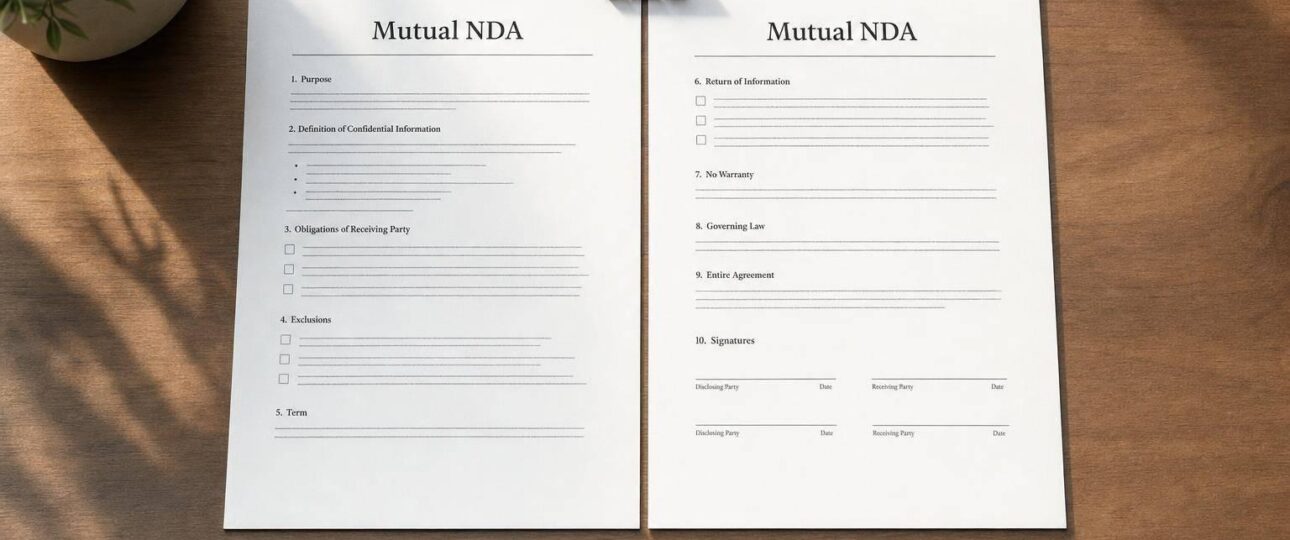
If both sides will share private business information, I use a mutual NDA before any files, numbers, or plans change hands. In most U.S. deals, the main points are simple: define what is protected, limit who can see it, set a clear purpose, add standard carve-outs, and pick a term that fits the deal – often 1–5 years for business information, with trade secrets protected as long as they stay secret.
Here’s the short version:
- Use a mutual NDA when both sides will disclose private information.
- Use a one-way NDA when only one side will disclose.
- List specific types of protected information like pricing, customer data, source code, budgets, and product plans.
- Include standard exclusions for public information, prior knowledge, independent work, and lawful third-party sources.
- Limit access to staff and advisors who need the information and already have written confidentiality duties.
- Set the term on purpose: many business deals use 2–5 years; lower-risk talks may use 1–3 years.
- Add return or destruction terms for files, notes, and digital copies when talks end.
- Check state law and court location before signing, because dispute costs can climb fast.
A fast way to think about it: if a leak could affect pricing, customers, deal terms, or sale talks, I want the NDA signed first.
| Topic | What to look for |
|---|---|
| NDA type | Mutual if both sides share; one-way if only one side shares |
| Protected information | Specific categories, not vague “all information” wording |
| Oral disclosures | Written follow-up, often within 5–10 business days |
| Term | Usually 1–5 years, depending on the data |
| Trade secrets | Protected as long as they remain secret |
| End of deal | Return or destroy materials and confirm it in writing |
| Disputes | Governing law, venue, and court-order disclosure language |
If I were filling out a template, I’d focus on balance, plain wording, and the few clauses that most often cause problems later.
How to Create a Mutual Non Disclosure Agreement [Templates Available]
sbb-itb-a688917
What a Mutual NDA Covers and How It Differs From a One-Way NDA
A mutual NDA puts confidentiality duties on both sides. Each party can act as the disclosing party and the receiving party.
A one-way NDA works differently. It binds only the receiving side. So if two parties are both sharing sensitive information, a one-way NDA can leave one side’s disclosures exposed. That’s why a mutual NDA needs to spell out what information is protected and who can see it.
What Counts as Confidential Information for Small Businesses
A well-drafted mutual NDA template should clearly state what falls under protection. For many small business deals, that usually includes trade secrets, source code, financial models, customer data, and other nonpublic deal information [1][2][4].
It should also cover different formats of disclosure, including written documents, electronic data, and oral conversations. Oral disclosures are often protected only if they’re confirmed in writing within 5 to 10 business days [1][2].
Instead of relying on vague wording like “all information,” the template should name the categories that matter to the deal. That makes the scope clearer and cuts down on gray areas.
When to Use a Mutual NDA Instead of a One-Way NDA
Use a mutual NDA when both sides plan to share sensitive information. Use a one-way NDA when only one side will disclose it.
| Situation | Recommended NDA Type |
|---|---|
| Evaluating a strategic partnership | Mutual NDA |
| Joint product development | Mutual NDA |
| M&A talks | Mutual NDA |
| Hiring a freelancer or contractor | One-Way NDA |
| Sharing a pitch deck with an investor | One-Way NDA |
One-way NDAs make sense for one-directional disclosures. Mutual NDAs work better when both parties need to share enough detail to judge the deal without leaving either side exposed.
That comes up most often in vendor talks, partnership discussions, and buyer negotiations.
Common Situations Where Small Businesses Use a Mutual NDA
Small businesses often use mutual NDAs during deal talks when both sides need to share private business information. The point is simple: each party needs enough detail to judge the opportunity without worrying that shared information will be misused.
Vendor and Supplier Discussions
Early vendor discussions often require you to open the curtain a bit. You may need to share operations, customer requirements, and forecasts so the vendor can tell whether they can meet your needs [1][4]. On the other side, vendors often disclose proprietary service methods, pricing structures, and technical specifications or integrations [1][3][4].
A mutual NDA covers both parties in these talks. It also lets you keep the purpose tight and specific, such as reviewing a possible distribution relationship.
This same setup often carries over when the conversation moves beyond a vendor relationship and into partner, joint project, or buyer discussions.
Partnership, Joint Project, and Buyer Talks
Partnership and joint project talks can get sensitive fast. You might share audience insights, marketing strategies, and product concepts [1][6]. The other side may also disclose proprietary frameworks, research, and financial details [1][6].
A mutual NDA gives both parties room to exchange that information while they decide whether the deal is worth pursuing.
The same kind of risk shows up in ownership or acquisition talks. Sellers may share financial records, customer lists, and operational details, while buyers may disclose valuation logic, financing structures, and strategic plans [3]. In acquisition discussions, a mutual NDA is often the standard starting point.
Key Clauses to Review Before Signing a Mutual NDA
Review each clause to make sure both sides carry the same duties.
Core Terms: Parties, Purpose, Confidential Information, and Exclusions
Start with the parties section. Use each party’s full legal name and entity type. Don’t rely on a trade name by itself.
The purpose clause matters just as much. Keep it tied to one clear deal purpose, like reviewing a vendor relationship, partnership, or acquisition. A loose phrase like “for general business purposes” can open the door to use that goes beyond what you meant to allow [2][4].
The definition of confidential information should point to clear categories such as customer lists, pricing logic, technical designs, and financial budgets. That works better than blanket wording like “any and all information shared.” The agreement should also include standard exclusions for information that is already public, that the other side knew before discussions started, that it built on its own, or that came from a lawful third-party source [7][11].
Once the parties, purpose, and scope are clear, look at who can see the information and how long the duty lasts.
Protection Terms: Access Limits, Permitted Disclosures, Term, and Return of Information
Limit access to employees, advisors, and contractors who need the information to do the work and who are already bound by written confidentiality duties [5][11].
Use a standard-of-care clause that says each side must protect the other side’s information with the same care it uses for its own sensitive data, and never less than reasonable care [1][7].
Add a compelled-disclosure clause. This lets a party comply with subpoenas or court orders after giving prompt notice to the other side [10][11].
For most business information, 2–5 years of protection is common. Trade secrets can stay protected as long as they remain secret [1][4]. The survival clause should say how long the confidentiality duties continue after the agreement ends. When talks end or the NDA expires, require the receiving party to return or certify destruction of all materials, including digital copies and derivative notes, and confirm that in writing [2][8].
After access and timing, check how the NDA deals with leaks, disputes, and enforcement.
Remedies, Governing Law, and a Clause Comparison Table
Two clauses small businesses often miss are injunctive relief and governing law. Injunctive relief lets you ask a court to stop further disclosure right away without first proving a set dollar loss. That matters because once private information is out, the damage can be hard to measure [10].
For governing law and jurisdiction, set both to your home state. If you have to fight a dispute somewhere else, costs pile up fast: travel, out-of-state lawyer fees, and the plain hassle of managing a case from afar. For a small business, that can make enforcement far harder in practice [1][2].
Before signing, check a few points:
- Are both parties defined as both Discloser and Recipient?
- Does the remedies clause apply the same way to both sides?
- Does the attorney’s fees clause help only one party?
If you spot a one-sided term, push back before you sign.
Use this quick comparison to catch weak drafting.
| Clause Type | Narrow/Specific Approach | Broad/Vague Approach |
|---|---|---|
| Confidential Information | Lists specific categories (e.g., "customer lists", "pricing logic"). Clear for staff and easier to enforce. May miss an unexpected data type. | Covers everything shared. Often ruled unenforceable or "read down" by courts for being overbroad. |
| Purpose | "To evaluate a potential joint venture." Limits misuse of shared data. | "For general business purposes." Recipient can argue broader internal use. |
| Term Length | 2–5 years. Commercially reasonable and defensible in court. | Perpetual for all information. Courts often void these for non-trade-secret data. |
| Remedies | Includes injunctive relief and attorney’s fees. Allows fast action to stop further disclosure. | Monetary damages only. Hard to quantify harm after a leak. |
| Exclusions | Explicitly carves out public and prior knowledge. Keeps the agreement more enforceable. | No exclusions listed. Often ruled unenforceable or heavily narrowed. |
Once these clauses are set, fill in the template fields with care.
How to Fill Out a Mutual NDA Template and Where to Find One
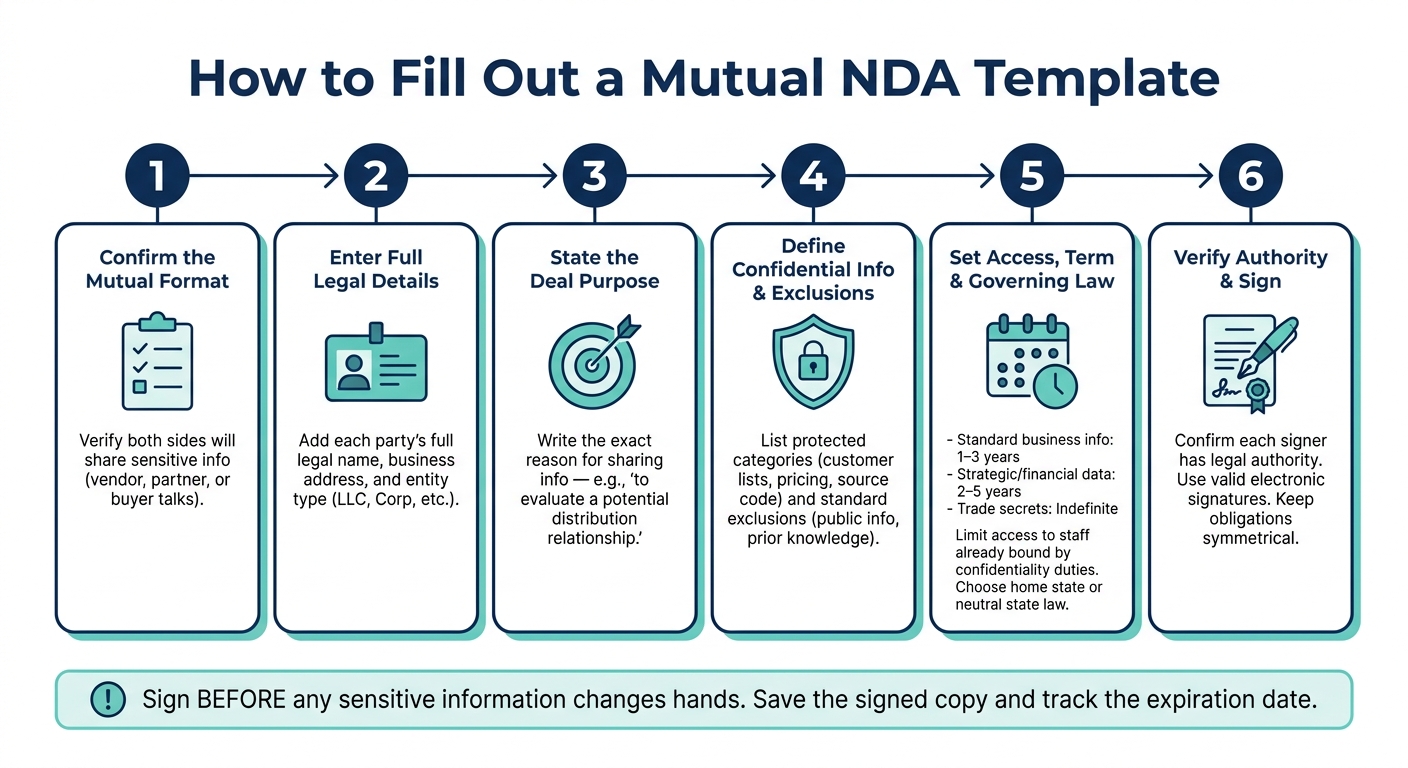
How to Fill Out a Mutual NDA Template: Step-by-Step Guide
Step-by-Step: How to Complete the Template Correctly
Fill out the template in this order.
- Confirm the mutual format is right for this situation Use a mutual NDA when both sides will share sensitive information in vendor, partner, or buyer talks.
- Enter full legal names, addresses, and entity types Add each party’s full legal name, business address, and entity type, such as LLC or corporation [1][9].
- State the deal purpose Say exactly why the information is being shared. For example: "to evaluate a potential distribution relationship" or "to assess a possible acquisition" [9][4].
- Define confidential information and set exclusions Use those terms exactly when you fill in the form. List the protected categories and the standard exclusions exactly as agreed [1][4][8].
- Set access, term, and governing law Limit access to people who are already bound by confidentiality duties [1][9][8]. Then use the table below to pick the term length and governing law that match the deal.
- Verify signatory authority and complete the signature blocks Make sure each side uses an authorized signer and a valid electronic signature [9][5]. The obligations should stay symmetrical.
A Decision Table for Choosing Term Length and Governing Law
| Option | Typical Duration / Choice | Best For |
|---|---|---|
| Standard Business Info | 1–3 years | Short-term vendor or contractor discussions with lower disclosure risk [1][4]. |
| Strategic / Financial Data | 2–5 years | Deep partnerships involving long-term roadmaps or margin assumptions [4]. |
| Trade Secrets | Indefinite | Information that must stay secret indefinitely and is backed by strict internal security [1][11]. |
| Home State Law | The state where your business is based | Keeps legal costs manageable and gives you a home-court advantage if litigation occurs [1]. |
| Neutral State Law | e.g., Delaware or New York | Parties in different states who want predictable commercial case law [2][11]. |
Using Small Business Legal Documents for Mutual NDA Templates
If you want a ready-made form, use a lawyer-reviewed template library. Small Business Legal Documents offers 2,000+ lawyer-reviewed templates and a simple customization tool to tailor a mutual NDA for vendor, partner, or buyer talks.
Conclusion: Key Steps to Use a Mutual NDA With Confidence
After you’ve reviewed the clauses and filled in the template, run through one last check before signing. A mutual NDA works best when the wording is precise, balanced, and signed before any sensitive information changes hands.
Pay close attention to the details that most often lead to disputes. In plain terms, double-check the term, the exclusions, and whether the person signing has the authority to do so.
Once the NDA is signed, save the final copy in a secure central folder and track the expiration date. That small admin step can save a lot of hassle later.
For vendor talks, partnership discussions, or buyer evaluations, a well-completed mutual NDA gives both sides room to share what they need to review the deal without taking on extra risk.
FAQs
Do I need a lawyer to review a mutual NDA?
Not always.
A standard template can be a good starting point, and you don’t need to have a lawyer draft or review every mutual NDA.
That said, some situations call for more care. If the NDA covers a lot of sensitive information, involves high-stakes negotiations, or includes clauses or legal rules you’re not sure about, talking to a lawyer is the safest move. It can help protect your interests and lower the chance of problems if you ever need to enforce the agreement.
What happens if someone breaches a mutual NDA?
A breach of a mutual NDA is a breach of contract. That means the party harmed by the breach may have grounds to sue.
Common remedies can include injunctive relief to stop any further disclosure, monetary damages to cover actual financial losses, and, if the agreement says so, payment of legal costs and attorney fees.
Can a mutual NDA be signed electronically?
Yes. A mutual NDA can be signed electronically, and electronic signatures are legally binding if the signer’s identity and intent can be verified under laws such as the ESIGN Act.
For small businesses, e-signatures can make the signing process faster and more efficient when starting partnerships or early-stage negotiations.