

A good negotiation clause can save you from a $25,000 to $75,000 dispute. I’d keep it simple: make notice required, set a firm 20- to 30-business-day timeline, require people with settlement power, pause the legal deadline, and state the next step if talks fail.
If I were reviewing a small business contract, I’d focus on five things right away:
- Scope: Does it cover any dispute arising out of or relating to the agreement?
- Notice: Does written notice start the clock?
- Timeline: Is there a fixed window, like 20 to 30 business days?
- Authority: Do the people in the meeting have power to settle?
- Escalation: Does the contract move to mediation, arbitration, or court after the deadline?
I’d also make sure the clause includes:
- Good-faith negotiation
- Confidentiality
- Tolling of the statute of limitations
- Remote meeting option
- Emergency court carve-out for things like trade secret leaks or IP misuse
Here’s the short version: a negotiation clause is the first step in a dispute process, not the whole process. It works best when the wording is clear, mutual, and tied to what happens next. For many small businesses, that can mean less delay, lower legal spend, and a better shot at fixing the problem before the relationship falls apart.
| What I’d Check | What I’d Want to See | Why It Matters |
|---|---|---|
| Scope | Broad dispute language | Stops side fights over whether the clause applies |
| Notice | Written notice by email or certified mail | Shows when the timeline starts |
| Deadline | 20–30 business days | Cuts down on stalling |
| Participants | Managers or executives with settlement power | Helps talks lead to a decision |
| Next step | Automatic move to mediation, arbitration, or litigation | Keeps the process from getting stuck |
If you use repeat contracts, I’d standardize this clause across your forms so you’re not fixing the same problem every time.
How to Read & Negotiate Commercial Contracts (Complete Guide for Business Owners
Core Elements of an Effective Contract Negotiation Clause
A negotiation clause works only when it gives the parties a clear process to follow. If the wording is loose, one side can drag things out or claim the clause does not even apply. That defeats the whole point. The strength of the clause comes down to how clearly it lays out the steps.
Scope, Notice, and Good-Faith Negotiation Requirements
Scope sets the boundary. It tells you which disputes must go through negotiation before anything else happens. A broad scope – such as "any dispute arising out of or relating to this Agreement" – pulls more disputes into the process. A narrow clause limited to "disputes regarding payment" leaves other issues open to immediate litigation, which makes the clause less useful.
Notice starts the negotiation clock. The clause should require formal written notice sent by certified mail or email with a read receipt. It should also state that giving notice is a required step before filing suit. [1]
Both sides should also have to take part in good faith and avoid using negotiation as a delay tactic. That duty should apply to each party, so both sides must respond and engage. Video negotiation can help cut cost and delay. It also makes sense to add an emergency carve-out so either party can go to court right away for injunctive relief in cases of irreparable harm, such as IP theft or trade secret disclosure. [1]
Those are the basic drafting choices that stop fights over the clause itself.
Once the clause says which disputes are covered, the next issue is simple: who has to negotiate, and on what timeline?
Participants, Deadlines, and What Happens If Negotiation Fails
Who attends the negotiation matters just as much as the schedule. The clause should require participants who have settlement authority. A two-tier setup often works well: operational staff first, then a senior decision-maker with settlement authority. [1]
Deadlines should be set in specific business days, not loose phrases like "promptly" or "no fixed deadline." A common setup is a 20- to 30-business-day negotiation window for each tier. The clause should also pause the limitations clock during negotiation. [1]
The clause also needs to say what happens if negotiation does not work. Name the next step – mediation, arbitration, or litigation – and make that move automatic once the deadline passes without a resolution.
Confidentiality matters too. The clause should state that all negotiation communications are confidential and inadmissible in later proceedings. If it does not, parties may hold back and say less than they otherwise would.
The table below shows why precise drafting matters.
Comparison Table: Clauses With Clear Terms vs. Vague Terms
| Element | Clear Term | Vague Term | Risk |
|---|---|---|---|
| Scope | "Any dispute arising out of or relating to this Agreement…" | "Disputes regarding payment…" | Other disputes may go straight to court. |
| Notice | Written notice via certified mail or email with read receipt | "Notice of dissatisfaction" | Unclear when the negotiation clock starts. |
| Deadlines | "20 to 30 business days per tier" | No fixed deadline | One party can stall indefinitely. |
| Authority | "Executives with full settlement authority" | "People with settlement authority" | Participants may not be able to resolve the dispute. |
| Limitations clock | Paused during negotiation | Omitted | The claim may become time-barred. |
| Escalation | "If unresolved after 30 days, move to mediation" | "Parties will try to settle before suing" | No clear next step; the dispute can stall. |
| Confidentiality | All negotiation communications are confidential and inadmissible | Omitted | Parties may hold back in discussions. |
The next section shows sample clause language that puts these terms into practice.
Sample Negotiation Clause Language and Common Clause Structures
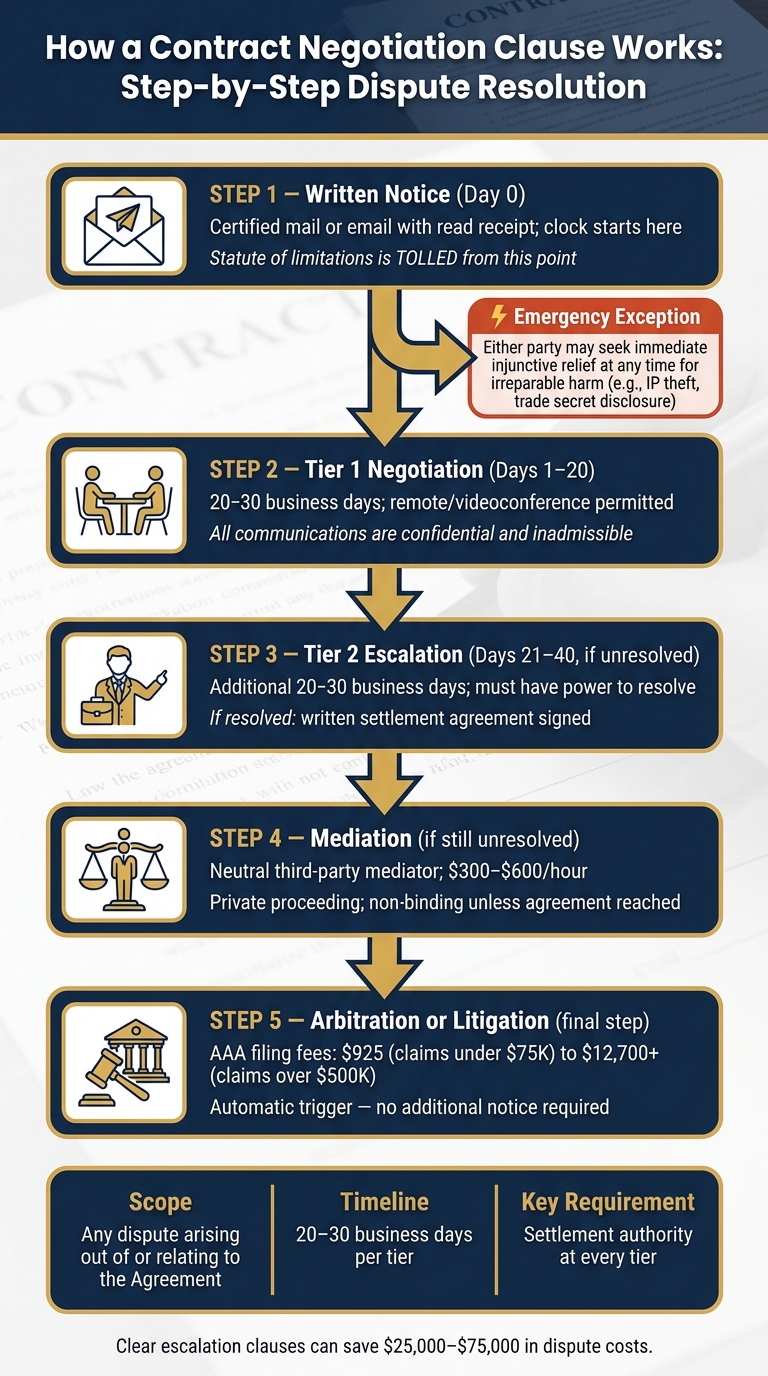
Contract Negotiation Clause: Step-by-Step Dispute Resolution Process
Seeing the clause on the page makes the drafting choices from the last section much easier to understand. The two examples below show the clause setups you’ll see most often in U.S. small business contracts.
They’re a good starting point, not plug-and-play language. You should tailor them to the deal, the parties, and how you’d want a dispute handled before anyone signs. These examples show what those rules look like in actual contract wording.
Basic Pre-Litigation Negotiation Clause
This setup fits service contracts, freelance agreements, and routine vendor deals. Here’s a practical place to start:
"Before either party files suit or starts arbitration, the parties shall give written notice of the dispute and engage in good-faith negotiation for 30 days. The limitations period is tolled during that time. Either party may seek immediate injunctive relief for irreparable harm."
This clause does four things: it requires written notice, calls for good-faith negotiation, pauses the limitations period, and keeps the door open for emergency relief. The word "shall" matters. It makes the negotiation step mandatory, and courts may pause or dismiss a case when a party skips that required pre-suit step.[1]
For bigger deals or contracts that last longer, one negotiation step often isn’t enough. That’s where a tiered process comes in.
Tiered Escalation Clause With Negotiation, Mediation, and Arbitration
A tiered clause makes sense for higher-dollar, long-term agreements like supply, SaaS, or construction contracts. Here’s a sample sequence:
"The parties shall first negotiate in good faith through designated representatives. If unresolved, a senior executive with settlement authority shall participate. If still unresolved, the parties shall proceed to mediation and then arbitration or litigation, as specified in the agreement."
The main drafting point here is simple: every trigger and deadline needs to line up exactly. If Step 2 is just the same conversation with a new title, it can slow things down without helping anyone.
Cost is also part of the decision. AAA filing fees start at $925 for claims under $75,000 and go past $12,700 for claims over $500,000. Mediator fees usually fall between $300 and $600 per hour.[1][2]
After you pick the structure, the next question is which drafting choices change cost, timing, and whether the clause holds up if a dispute lands in court or arbitration.
Comparison Table: Simple Negotiation-Only vs. Multi-Step Escalation Clauses
| Feature | Simple Negotiation-Only | Multi-Step Escalation |
|---|---|---|
| Cost | Lowest – only internal staff time. | Moderate – mediator and arbitrator fees if negotiation fails. |
| Speed | Fastest; usually 15–30 days. | Slower; may take 60–120+ days to work through all tiers. |
| Complexity | Low; easy to draft and follow. | High; timelines and triggers must align exactly. |
| Enforceability | Strong if timeframes are clear. | Strong, but skipping a step can delay or derail legal action. |
| Privacy | Low if it leads to public litigation. | High; mediation and arbitration are private proceedings. |
| Best fit | Service contracts, freelance work, and lower-value deals under $25,000. | Long-term supply, SaaS, or construction deals where privacy and a step-by-step process justify the added cost. |
sbb-itb-a688917
Drafting and Negotiating These Clauses for Small Business Agreements
With the structure in place, the next step is making sure the clause still works when things get tense. Small drafting choices – who has to participate, how time gets counted, and whether both sides have the same duties – can decide whether the clause helps or just creates another fight.
Drafting Choices That Affect Cost, Timing, and Enforceability
Once the structure is set, the fine print does the heavy lifting.
One of the most missed choices is location and format. If the clause forces in-person talks in the other party’s state, even a small dispute can become too expensive to chase. Travel costs, lost time, and hassle add up fast. A simple fix is to say, in plain terms, that either side may participate remotely by videoconference.
Deadlines are another weak spot. Vague wording like "if the dispute is unresolved after 30 business days of written notice" can cause arguments about when the clock starts, what counts as a business day, or whether one side did enough to take part. It’s better to use a clear time trigger and make participation reciprocal, so both parties have the same duty to engage.
It also helps to add tolling, confidentiality, and emergency-relief language. And if the talks go nowhere, the clause should say exactly what comes next – whether that’s mediation or arbitration.[1]
If you use the same contract again and again, don’t reinvent the wheel each time. Turn these decisions into a standard form so every new deal starts from the same base.
Using Templates and Internal Playbooks for Repeat Contracts
If your business signs the same kind of agreement more than a few times a year, it makes sense to standardize the negotiation clause. Start with one approved version, then keep a fallback list for terms you can trade and a no-go list for terms that need legal review.
Small Business Legal Documents offers 2,000+ lawyer-reviewed templates and a jurisdiction selector for matching governing law. That matters because statutes of limitations change from state to state. For instance, Florida gives five years from the date of breach for written contract claims.[3]
Negotiation-Clause Priorities by Contract Type
Not every contract needs the same level of dispute-resolution detail. A client service agreement usually calls for one set of priorities, while a lease or contractor agreement may need another.
| Contract Type | High Priority (Insist On) | Flexible (Negotiable) |
|---|---|---|
| Client Service | Written notice requirement, 30-day negotiation window, escalation trigger | Negotiation format (in-person vs. remote), tier count |
| Vendor Agreement | Tolling clause, confidentiality of negotiation communications, next-step trigger | Mediation vs. arbitration as Step 2 |
| Independent Contractor | Reciprocal participation, settlement authority requirement | Negotiation deadline length |
| Creative Project | Emergency injunctive-relief carve-out, confidentiality | Escalation timeline buffers |
| Commercial Lease | Defined notice method, limitations tolling, clear escalation path | Mediator selection process |
Conclusion: How to Build a Negotiation Clause That Works in Practice
The strongest negotiation clauses tend to be simple, specific, and aligned with the rest of the contract. In day-to-day use, an effective clause should spell out the scope, require written notice, set fixed deadlines, name people with actual decision-making power, and impose a good-faith duty before either side moves to the next step. For small businesses, clarity matters more than complexity.
A practical setup usually includes broad scope language, written notice that starts the clock, a 20- to 30-business-day negotiation window, and participants with real settlement authority.
When that window ends, the clause should move straight to the next tier without extra debate. The escalation path should happen automatically: negotiation first, then mediation, then binding arbitration or litigation, with tolling while the parties try to settle. That way, the negotiation clause works as the first step in a larger dispute-resolution process instead of turning into a dead end.
For recurring agreements, consistency across forms can head off disputes before they start. If you use repeat contracts, stick with one standard template so the clause stays the same across agreements. Small Business Legal Documents offers 2,000+ lawyer-reviewed templates and a jurisdiction selector for repeat contracts. Specific, mutual, and consistent clauses are easier to follow, enforce, and reuse.
FAQs
Is a negotiation clause legally enforceable?
It depends on the exact wording of the clause and the law that governs the contract. A clause like this can set a required step for handling disputes before either side moves to the next stage. But whether a court will enforce that step may be limited by state law.
Courts often look at one key point: does the clause require the parties to negotiate in good faith, or does it amount to nothing more than an unenforceable agreement to agree? That line can be thin, and it shifts from state to state. Because of that, it’s smart to consult a local attorney.
When should I choose mediation, arbitration, or litigation?
Start with a tiered process. Begin with good-faith negotiation for 30 to 60 days, then move to mediation if needed.
Mediation is often the best first step after direct talks because it can settle disputes in private without a binding decision. That gives both sides room to work things out without being locked into an outcome too early.
If mediation doesn’t work, move to arbitration for a final, enforceable private decision. Leave litigation as the last resort. It’s public, slower, and usually more expensive.
Can a negotiation clause be one-sided, or should it be mutual?
A negotiation clause should ideally be mutual. That helps keep risk balanced and gives both sides a clear path for dealing with disputes.
One-sided clauses are common. But they can be a red flag. Why? Because they often push more risk or leverage onto one party than the other.
If a clause isn’t mutual, it’s usually worth pushing back on it, especially when you’re dealing with terms like indemnification, liability caps, and fee-shifting.