

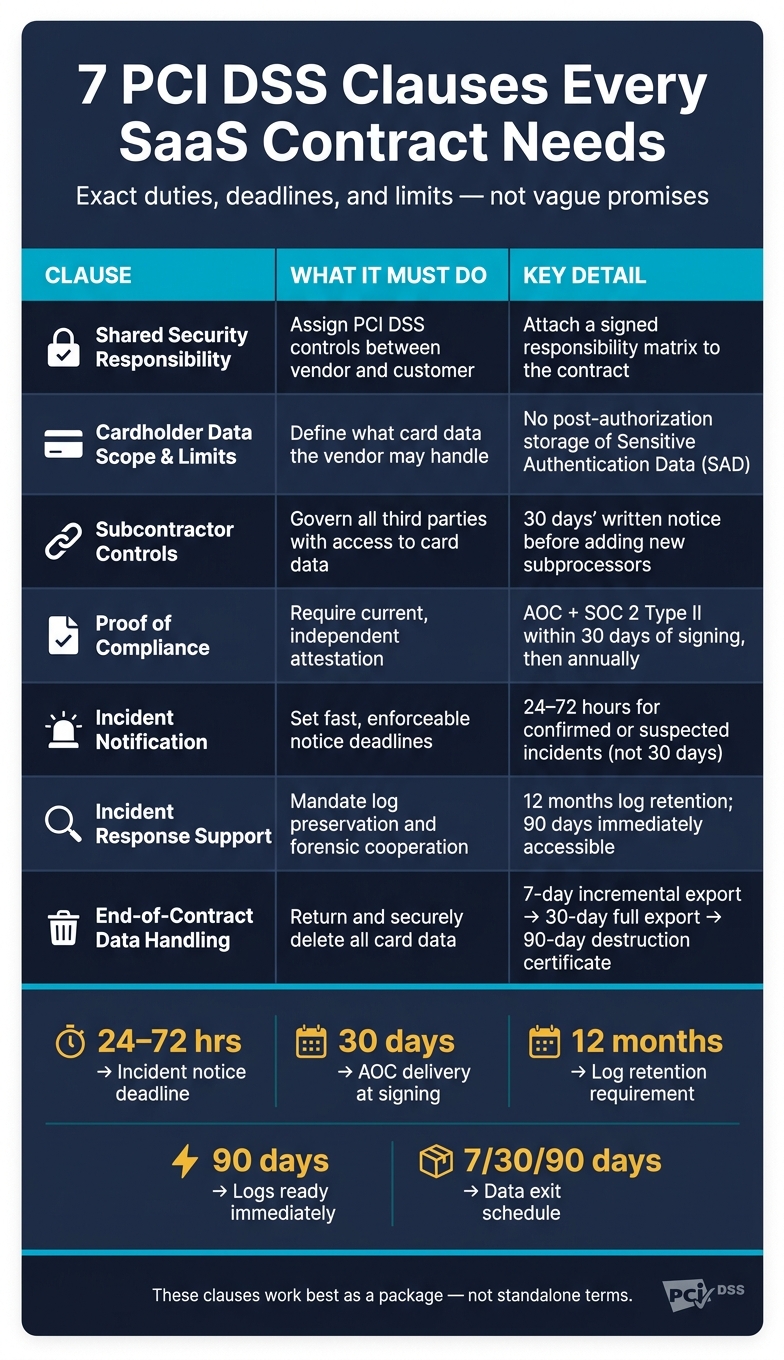
If a SaaS contract touches payment card data, vague security terms are not enough. I’d want the deal to clearly cover 7 things: who handles which PCI tasks, what card data the vendor may touch, which subcontractors are allowed, what proof of compliance must be shared, how incident notice works, what help is required after an incident, and how data is returned or deleted at the end.
Here’s the short version:
- Split duties in writing. A shared responsibility matrix should show who owns each PCI control.
- Limit card data scope. The contract should say what cardholder data the SaaS provider can process and ban storage of sensitive authentication data after authorization.
- Control subcontractors. New subprocessors should trigger notice, and the vendor should stay liable for them.
- Ask for proof. A current AOC, and sometimes SOC 2 Type II, should be delivered at signing and then every year.
- Set tight incident deadlines. Many PCI deals use 24 to 72 hours, not the 30 days found in many standard vendor terms.
- Require investigation support. Logs, evidence retention, and root cause reporting should be spelled out.
- Close the exit gap. Data return and deletion should follow a clear 7/30/90-day timeline.
A few numbers stand out. PCI-related contracts often require incident notice in 24 to 72 hours. Proof of compliance is often due within 30 days of signing and then annually. Log retention commonly runs 12 months, with 90 days ready right away.
7 PCI DSS Clauses for SaaS Contracts: Weak vs. Strong Language
Navigating PCI Compliance at Scale: Managing Service Providers & Assurance
sbb-itb-a688917
Quick Comparison
| Clause | What it should do | Key timing or detail |
|---|---|---|
| Shared security responsibility | Assign PCI tasks between vendor and customer | Attach matrix to the contract |
| Cardholder data scope and limits | Limit what CHD the vendor may handle | No post-authorization SAD storage |
| Subcontractor terms | Control downstream vendors | 30 days’ notice before new subprocessors |
| Proof of compliance | Show current PCI status | AOC at signing and yearly |
| Incident notification | Set notice rules for suspected or confirmed incidents | 24 to 72 hours |
| Incident response support | Require logs, evidence hold, and cooperation | 12 months retention; 90 days ready |
| End-of-contract data handling | Return and delete card data | 7/30/90-day exit schedule |
If I were reviewing a SaaS deal for PCI risk, I’d treat these clauses as one package, not stand-alone terms.
Why PCI DSS Clauses Matter in SaaS Contracts
General security language is too vague for PCI DSS. If the contract doesn’t spell out the required controls, neither side has a clear way to enforce the standard. That first clause turns a fuzzy promise into shared security responsibility.
These rules only work when the agreement clearly names the CDE, each party’s duties, and the oversight terms. If the contract doesn’t define the cardholder data environment, assign specific security duties, or explain how subcontractors are managed, the customer is left with compliance gaps.
Speed matters most during an incident. PCI deals often require notice within 24 to 72 hours of discovery [5][1][7]. That’s far tighter than the 30-day window found in many standard vendor agreements [6]. Buyers need that fast notice so they can meet their own reporting duties.
It’s not just about promises on paper, either. Requiring the vendor to provide its latest independent attestation, such as a SOC 2 Type II report or an Attestation of Compliance (AOC), within 30 days of contract execution and every year after that makes compliance easier to verify. Without that documentation, proving compliance gets messy fast. That’s why the next clause starts by assigning shared security duties.
1. Shared PCI DSS Security Responsibility Clause
This clause assigns PCI DSS duties. Without it, shared controls turn into a gray area fast.
Match the clause to PCI DSS Requirements 12.8.5 and 12.9, and attach a responsibility matrix that assigns each relevant control to the provider, the merchant, or both. Add the provider’s written acknowledgment of responsibility for any cardholder data it handles or can affect.
Requirement 12.9 is meant to align service providers and customers on their PCI duties.
The matrix only works if "shared" controls are split in plain terms. Calling a control shared without setting the line is no better than not assigning it at all. Here’s what a workable split looks like: the provider manages the Web Application Firewall (WAF) infrastructure, while the merchant manages rule tuning and alert monitoring.
| Control Area | SaaS Provider | Merchant |
|---|---|---|
| Data Center Security | Physical security of data centers and server hardware | Office access and end-user devices |
| Network Security | Firewall/WAF baseline setup | Rule tuning and alert monitoring |
| Access Control | Platform backend security and staff MFA | User credentials, roles, and access reviews |
| Vulnerability Management | Platform, OS, and provider-app patching | Merchant-side integration patching |
One more thing: the matrix needs to be legally tied to the contract, not left as a side document that nobody checks later. Reference it directly in the Master Subscription Agreement (MSA) or in a PCI-specific addendum. If the matrix says the provider patches the OS, the Statement of Work (SOW) should say so in clear terms.
After duties are assigned, spell out exactly what cardholder data the SaaS platform may touch. Then narrow the cardholder data scope so the responsibility matrix has firm boundaries.
2. Cardholder Data Scope and Limits Clause
Once the responsibility matrix is set, spell out exactly what cardholder data the provider can touch. This clause draws a hard line. It keeps the provider from handling more payment data than the service needs.
Under PCI DSS, cardholder data (CHD) includes the Primary Account Number (PAN), cardholder name, expiration date, and service code. The PAN must be made unreadable anywhere it is stored through encryption, truncation, tokenization, or one-way hashing [9].
Sensitive Authentication Data (SAD) is a separate category. It includes full magnetic stripe or chip data, card verification codes, and PINs or PIN blocks. This data must not be stored after authorization, even if it is encrypted [9].
The clause should also define the Cardholder Data Environment (CDE) as all systems that store, process, or transmit CHD, along with connected systems [9]. In plain English, if a system touches card data or links to a system that does, it may fall into scope.
The contract should plainly bar any post-authorization storage of SAD [9]. It can also require tokenization or a third-party checkout system, so raw card data never enters the SaaS platform’s systems at all [1]. That’s a clean way to keep connected systems from pulling more of the business into PCI scope.
Once scope is fixed, the next clause should control who else can expand it.
3. Subcontractor and Third-Party Service Provider Clause
Once a contract narrows the scope of cardholder data, it also needs to control every outside vendor that could widen that scope again. That means the clause has to cover every third party with access to cardholder data. If the contract is vague here, those vendors turn into a compliance blind spot.
PCI DSS Requirement 12.8 calls for written controls for each service provider that can touch cardholder data. That includes a maintained list of service providers, written agreements with each one, and annual compliance monitoring [3]. The main SaaS provider should also have to bind any subprocessors to the same PCI DSS terms in the customer contract and push those same duties down through its own vendor agreements [5][6].
The contract should also spell out notice and approval rights for subprocessors. In plain English: the SaaS provider must keep an up-to-date list of subprocessors and give the customer at least 30 days’ written notice before adding a new one, along with a right to object [11][6].
| Feature | Weak Drafting | Strong Drafting |
|---|---|---|
| Subprocessor approval | General approval; no objection right [6] | 30 days’ prior notice; customer may object to any new subprocessor [11][6] |
| Flow-down terms | Vague statement that vendor is responsible for its "affiliates" [6] | All subcontractors must sign equivalent PCI DSS compliance terms [5][6] |
| Liability for failures | Liability capped at 12 months of fees; silent on subcontractor actions [6] | Vendor remains fully liable for subprocessor compliance; breaches carved out of liability caps [6] |
| Audit rights | No audit rights or limited to a summary report [6] | Annual audit rights or a full SOC 2 Type II report within 30 days of request [5][6] |
There’s another catch here. Many SaaS vendors carve out major infrastructure providers like AWS or Azure from their own SOC 2 reports. So even if the top-line vendor looks fine on paper, part of the stack may sit outside that report. Strong contracts deal with this by requiring the customer to separately verify those subservice organizations’ controls through their own Attestations of Compliance (AOCs) or SOC 2 reports [6].
That paper trail sets up the next clause: proof of PCI DSS compliance.
4. Proof of PCI DSS Compliance Clause
Once the provider’s security duties are spelled out, the clause should ask for current proof, not just a broad promise.
Require a current Attestation of Compliance (AOC) – the signed summary of the provider’s assessment results meant for customer review. The validation document should match the provider’s level: ROC + AOC for Level 1 providers, or SAQ D for Service Providers + AOC for smaller providers. The ROC is confidential and usually isn’t shared with customers [3][2][10].
The contract should also require annual AOC delivery on a fixed date, set when the contract is signed and then repeated each year after that [5]. PCI DSS Requirement 12.8.4 sets the baseline at annual monitoring, but in higher-risk deals, it often makes sense to spell out quarterly reviews as well [3].
Two drafting points matter here:
- The AOC must cover the actual service and environment.
- The provider should deliver the current shared responsibility matrix with the AOC, in line with PCI DSS Requirement 12.8.5 [3][12].
Require the right validation package for the provider’s level, plus quarterly ASV scans where they apply [3][2][10].
The clause should also deal with status changes. If the provider loses its PCI DSS compliance status, the contract should require written notice within 24 to 72 hours, so the customer has a clear trigger for remediation or contract action [6][8].
5. Incident Notification Clause
When a security incident touches cardholder data, speed matters. This clause spells out when the SaaS provider has to notify the merchant, what that notice needs to say, and who should get it. The next drafting point is simple: how fast the provider has to speak up.
Use a 24- to 48-hour initial alert, then require a detailed written report within 72 to 120 hours [7][14][6].
For a confirmed compromise, require immediate notice. For suspected incidents, set a 48- to 72-hour deadline. The contract should also define discovery as the point when the provider reasonably suspects an incident [5][6].
The SaaS provider should send notice to the named security contacts listed in the contract. And the merchant should control any external notices to regulators, card brands, and customers [13][11]. That matters because fast vendor notice helps the merchant meet its own reporting duties. The contract should also require immediate help with the investigation and any forensic work.
The notice itself should include:
- the nature and scope of the incident
- the affected record types and volume
- remediation steps
- root cause
- the remediation timeline
- a provider contact [5][14][6]
6. Incident Response and Forensic Support Clause
After notice, the provider must preserve evidence and help with the investigation. The contract should say this in plain terms: preserve evidence right away and support the investigation without delay.
The main duty here is mandatory cooperation. On request, the provider should hand over relevant security logs and artifacts in a usable format [5][14]. The contract should also require log retention for at least 12 months, with 90 days available right away, and those records must be protected from alteration or destruction when an incident is reasonably suspected [1][2].
Once the evidence is locked down, the contract should also spell out who pays. That matters because forensic work can get expensive fast, especially if the card brands require a PCI Forensic Investigator (PFI) [10]. A good clause states clearly that remediation and forensic costs are at the vendor’s expense when the incident stems from the provider’s failure. It can also help to negotiate a higher liability cap for breach claims, since a standard cap tied to 12 months of fees may not go very far in practice.
Here’s how the response duties usually split:
| Duty | SaaS Provider | Merchant |
|---|---|---|
| Investigation | Provide logs, artifacts, and system access | Lead the investigation; retain a forensic investigator |
| Containment | Patch vulnerabilities; isolate affected systems | Revoke compromised credentials; monitor endpoints |
| Remediation | Fix the root cause; confirm the issue is addressed | Validate remediation; update internal policies |
For high-severity incidents, require a written root cause analysis within 7 to 14 days [14]. That report can support card brand and regulatory responses.
7. End-of-Contract Data Return and Destruction Clause
When a contract ends, cardholder data doesn’t just vanish. It can still sit in a vendor’s live systems, backups, and subcontractor environments. That means PCI work doesn’t stop with notice and forensic support. It also carries into contract exit, and this clause is meant to close that offboarding gap after incident response.
The vendor should be required to return all cardholder data in a machine-readable format, such as CSV or JSON, and then securely delete every copy [15][4]. That includes transaction history, payment tokens, and any copies stored in backups or replicated systems. A clear 7/30/90 schedule works well here: an initial incremental export within 7 days, a complete export within 30 days, and a written destruction certificate within 90 days of termination [15].
The deletion standard also needs to be plain and specific. PCI data should be securely deleted or rendered unrecoverable through cryptographic erasure or secure overwriting [16]. If legal or regulatory retention rules force the vendor to keep some records, the clause should require the vendor to isolate that data from the cardholder data environment and document the legal or regulatory basis for keeping it [16]. Any retained records must exclude SAD.
Once destruction is finished, the vendor should provide written certification that confirms the scope of deletion, the method used, and that all locations were covered, including backups and subcontractor systems [6][16]. Clear deadlines and direct deletion standards matter here because they turn the clause into an enforceable duty, not just a policy statement.
Clause Drafting Examples: Weak vs. Strong Language
Weak clauses rely on fuzzy standards. Strong clauses spell out exact duties, limits, and deadlines. That matters because loose wording gives people room to argue later. Tight wording gives you something you can point to and enforce.
The examples below show how to sharpen the seven PCI clauses above. Each row matches vague drafting with language that sets a clear rule.
| Clause Type | Weak Language | Stronger Alternative | PCI DSS Risk Addressed |
|---|---|---|---|
| Shared PCI DSS Security Responsibility | "Vendor will use best efforts to secure data." | "Vendor shall maintain administrative, technical, and physical safeguards for all cardholder data it stores, processes, or transmits, including MFA for privileged access and encryption in transit and at rest." | Unclear responsibility |
| Cardholder Data Scope and Limits | "Vendor provides an analytics platform for customer use." | "Vendor shall process Cardholder Data solely to provide the Services and shall not use it for model training or any secondary use without Customer’s prior written consent." | Scope creep |
| Subcontractor and Third-Party Service Provider | "Vendor may use third-party service providers at its discretion." | "Vendor shall provide a current list of subprocessors, obtain Customer’s prior written approval before adding new ones, and ensure all third parties are bound by equivalent PCI DSS compliance obligations." | Downstream vendor risk |
| Proof of PCI DSS Compliance | "Vendor represents that it is compliant with industry security standards." | "Vendor shall provide its most recent PCI Attestation of Compliance (AOC) and SOC 2 Type II report within 30 days of signing and annually thereafter." [5][6] | Missing evidence of compliance |
| Incident Notification | "Vendor will notify Customer of a data breach within 30 days." | "Vendor shall notify Customer of any confirmed or reasonably suspected security incident within 72 hours of discovery and provide forensic logs and root cause analysis." [5][7] | Delayed notice |
| End-of-Contract Data Return and Destruction | "Data will be handled according to Vendor’s standard retention policy." | "Within 30 days of termination, Vendor shall return all data in machine-readable format or securely delete it and provide written certification of destruction." [7][6] | Improper data destruction |
A simple pattern shows up across all six examples: weak clauses lean on broad promises like best efforts or industry standards. Strong clauses name the action, the scope, and the deadline. That shift may look small on paper, but it’s often the difference between a clause that sounds good and one that holds up when something goes wrong.
These examples can serve as a starting point for a customizable contract template. If your team wants a head start, Small Business Legal Documents offers customizable, lawyer-reviewed templates.
Conclusion
These clauses work best as a package, not as standalone terms. Put together, they turn PCI DSS requirements into SaaS contract terms that parties can actually enforce. That setup matters most when compliance needs to be checked, incidents must be reported, and the contract needs to end without a mess. It also makes compliance reviews, breach response, and contract exit more predictable.
Small Business Legal Documents offers customizable, lawyer-reviewed templates that can provide a useful starting point.
Strong PCI clauses do more than shift risk from one side to the other. They put a clear process on paper. The goal is simple: name the duties, set the deadlines, and make responsibility clear.
FAQs
When does a SaaS vendor fall under PCI DSS?
A SaaS vendor falls under PCI DSS if it accepts, stores, processes, or transmits cardholder data in any way. That rule applies no matter how big the company is, where it operates, or how many transactions it handles.
Using a third-party payment processor doesn’t automatically remove that duty. The vendor still needs to make sure cardholder data never touches its own systems, and it still has to keep up its own validation, such as an annual Self-Assessment Questionnaire.
What evidence should I request before signing?
Before you sign, ask for independent proof of the vendor’s security posture. That usually means an annual PCI attestation and either a SOC 2 Type II report or an ISO 27001 certificate. Make sure those documents cover the right scope and are provided within 30 days of contract signing.
You should also ask for:
- A current subprocessor list
- Documented vulnerability management
- Evidence of patch deployment
If an on-site audit isn’t practical, confirm that you still have the right to request remediation plans and supporting incident evidence.
How do I reduce PCI scope in a SaaS deal?
Keep your system’s contact with credit card data as small as possible. Start by mapping your network and data flow so you can see exactly where cardholder data touches your setup. Then, when you can, use third-party payment providers so cardholder data never passes through your own systems.
For any data you still handle, use tokenization and isolate the cardholder data environment with network segmentation. That way, more of your platform can stay outside stricter PCI DSS scope.