

Severance is usually optional, but the paperwork is not something I’d treat lightly. In most cases, a small business can use a simple formula – 1 to 2 weeks of base pay per year of service, often capped at 26 weeks – but the right template depends on the type of exit, the employee’s age, and state final-pay rules.
Here’s the short version:
- I’d keep severance separate from final wages and unused PTO
- I’d use a release of claims only when the employee gets pay they were not already owed
- I’d spell out payment timing, COBRA terms, property return deadlines, and tax withholding
- I’d use 21 days for an individual worker age 40+, or 45 days for a group layoff, plus a 7-day revocation period
- I’d switch templates based on the situation: standard exit, layoff, performance-related exit, group RIF, larger package, or internal checklist
If I were choosing fast, I’d match the document to the exit reason first, then check age, state law, and whether I want lump-sum pay or salary continuation.
Quick Comparison
| Template Type | Best For | Common Pay Setup | Main Watch-Out |
|---|---|---|---|
| Standard severance agreement | One-person exit | 1–2 weeks per year | Release wording |
| Layoff template | Budget cuts or restructuring | Min. 2 weeks, max 26 weeks | Final-pay timing by state |
| Performance termination template | Employee-related exit | 1–2 weeks per year, cap at 26 weeks | Keep fault details out |
| Group RIF template | 2+ workers laid off together | Tenure-based formula | 45-day review + age/job-title disclosures |
| Larger-package template | Senior or long-tenured staff | Expanded pay or added perks | Equity, bonus, and COBRA terms |
| Internal checklist | HR/process use | Same approved formula each time | Consistency and legal checks |
A simple template can work. But if the exit involves a dispute, a multi-state team, or anyone age 40 or older, I’d slow down and check the legal steps before sending anything out.
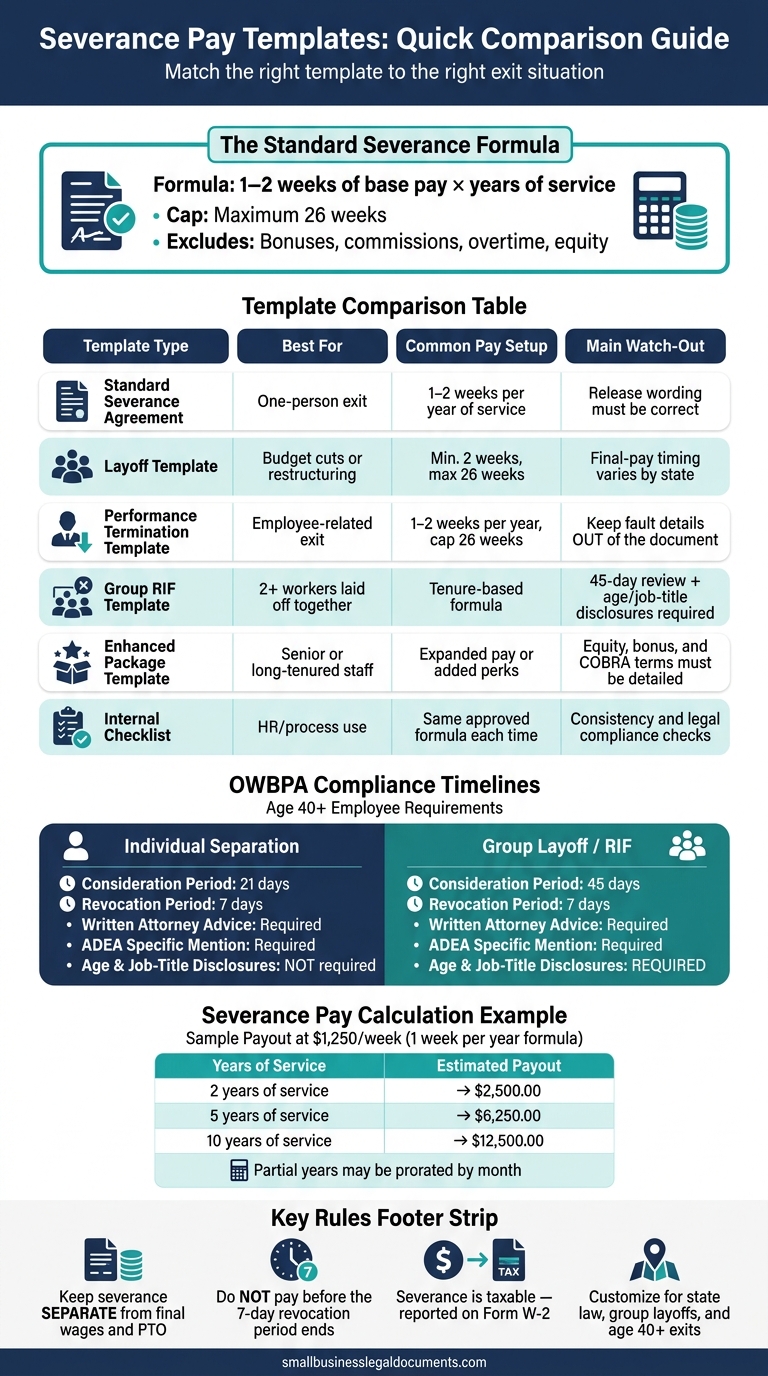
Severance Pay Templates for Small Businesses: Which One Do You Need?
What Every Severance Pay Template Should Include
A good severance template starts with the basic facts. That means the full legal names, addresses, and contact details for both sides, along with the employee’s last day of work and the agreement’s effective date. It should also have signature lines and spaces for dates.
Then come the money and benefits terms. These need to be plain and exact. Define base salary as the employee’s annual rate in effect on the separation date, and make clear that bonuses, commissions, and overtime are not included. Spell out the exact severance amount, whether it will be paid in a lump sum or through salary continuation, when payments will start, and how they will be delivered. The agreement should also say that severance is treated as taxable wages, paid minus withholdings and reported on a Form W-2.[3][5]
Benefits need the same level of detail. State the last day of health coverage, whether the employer will subsidize COBRA, and how long that subsidy lasts. Under federal law, departing employees can continue group health coverage for up to 18 months at their own cost through COBRA.[2][5] You’ll also want to cover any retirement contribution terms and say whether accrued PTO will be paid out under the law that applies. On top of that, set a 5- to 7-business-day deadline for returning company property, including laptops, badges, access credentials, data, and files.[4][8]
The release of claims is the part that ties the deal together. In exchange for severance, the employee agrees to release claims such as wrongful termination, discrimination, and breach of contract. At the same time, the release should have carve-outs. It should not block the employee from filing an EEOC charge, seeking unemployment benefits, or pursuing workers’ compensation.[5]
Confidentiality and non-disparagement clauses need a careful touch. The safer route is to keep them narrow. For example, they can bar false statements of fact, but they should not ban all negative comments. That helps avoid speech limits that go too far.[5] Most templates also include standard contract terms like governing law, severability, and an entire-agreement clause. And if the employee is 40 or older, the template needs OWBPA timing and disclosure language too.
For employees age 40 or older, the agreement must specifically mention ADEA rights, advise the employee in writing to consult an attorney, and give the right review period. That means 21 days for an individual separation or 45 days for a group layoff or reduction in force. After the employee signs, there is still a 7-day revocation period, so severance payments should not start until that window has passed.[5][2] Miss those steps, and the age-discrimination waiver can fall apart.
Use the timelines below to match the template to the type of separation.
| Requirement | Individual Separation (Age 40+) | Group Layoff/RIF (Age 40+) |
|---|---|---|
| Consideration Period | 21 days | 45 days |
| Revocation Period | 7 days | 7 days |
| Written Attorney Advice | Required | Required |
| ADEA Specific Mention | Required | Required |
| Age and job-title disclosures | Not required | Required |
Use these rules to match the right template to the right situation.
sbb-itb-a688917
1. Small Business Legal Documents Severance Agreement Template

Use this template for a standard one-person separation when you want an agreement that’s ready to go. The Small Business Legal Documents severance agreement template is a lawyer-reviewed Word file built for small businesses. A one-time Lifetime Membership costs $149. [7][11]
U.S. Severance Formula Structure
It follows the standard U.S. approach: one to two weeks of base pay for each completed year of service. [2][3][5]
Release and Compliance Clauses
The template includes a release of common employment claims. It also adds a payment-suspension clause, which lets the business pause salary-continuation payments if the employee breaches a noncompete or confidentiality term. [11][3][12][2]
Benefits Continuation Terms
It spells out when coverage ends, whether COBRA gets subsidized, and how retirement balances and unvested equity are treated. [2][6][5]
Customization for Small-Business Scenarios
The customization tool plugs in party names and governing law, which saves time on setup. For states with stricter rules, use a jurisdiction appendix. The template also supports both lump-sum and salary-continuation payment structures. [7][8][2]
For layoffs affecting multiple employees, use the reduction-in-force template next.
2. Layoff Severance Pay Template
Use this template for business-driven separations, like budget cuts or restructuring. Keep the wording neutral. The point is to document the business reason for the separation, not to point to employee fault or performance issues.
U.S. Severance Formula Structure
A common setup is a tenure-based formula of one to two weeks of base pay for each completed year of service, with a minimum of two weeks and a maximum of 26 weeks. This formula should exclude bonuses, commissions, overtime, and equity. [2][4]
Release and Compliance Clauses
Severance should depend on the employee signing a release of claims if you want that release to be enforceable. [2][8] For employees age 40 or older, follow the OWBPA timing and revocation rules before severance payments begin.
Final wages must be handled separately. That includes accrued vacation pay where state law requires it, and those amounts must be paid by the legal deadline whether or not the employee signs a release. [9][12]
Benefits Continuation Terms
State the last day of benefits coverage and spell out whether the company will help with COBRA premiums. In many cases, employers cover one to three months. [2][12] A one- to three-month COBRA subsidy is a practical add-on that can make the package easier for employees to manage. [2][5]
Customization for Small-Business Scenarios
For small businesses, it often makes sense to set a minimum tenure threshold of 90 days to 6 months. [2][8] You can use:
- A lump-sum payment for simplicity
- Salary continuation if you want the option to suspend payments in certain cases [2]
If you have employees in more than one state, check local final-pay deadlines before you lock in the template. California is a good example: it requires same-day final pay for involuntary terminations. [8][12]
If the separation is tied to performance or conduct instead of business reasons, use the next template.
3. Performance Termination Severance Agreement Template
Use this template when the separation is tied to the employee, but keep the agreement neutral and focused on the release. The main rule is simple: leave disciplinary details out of the severance document. If you mix fault findings with a discretionary severance offer, you can weaken the release and make it harder to enforce. If severance follows a performance issue, use neutral separation language that fits the actual decision. This version is meant for individual, employee-related separations rather than business-driven ones. [1]
U.S. Severance Formula Structure
Use the same tenure-based formula each time: one to two weeks of base pay per completed year of service, capped at 26 weeks. [2][1] In the agreement, define base salary as the employee’s annual base rate in effect on the separation date, excluding bonuses, commissions, and overtime. That point matters. If you leave it vague, a departing employee may argue that commissions belong in the formula too, which can push the payout much higher. [2]
Release and Compliance Clauses
If you offer severance, the signed release is the consideration behind the agreement. Do not issue payment before the release is signed and any revocation period that applies has expired. [5]
Keep confidentiality and non-disparagement clauses narrow. Broad bans on discussing working conditions can be unlawful. For non-disparagement, limit the clause to false statements instead of banning all negative statements. [5]
Customization for Small-Business Scenarios
Salary continuation can work well in this setup because payments may stop if the employee breaks post-separation obligations. [2][1] Add a clawback clause that lists the exact triggers for suspension or repayment.
Also spell out a firm deadline for returning company property, such as laptops and access badges. Revoke system access at a set time on the employee’s last day. [1][8]
For multiple employees, use the group reduction-in-force template next.
4. Group Reduction-in-Force Severance Template
Use this template when you’re laying off two or more employees at the same time because of restructuring, budget cuts, or a downturn. It builds group-layoff compliance into the process from the start. That matters because a group RIF has more legal steps than a one-person layoff, especially around age disclosures and WARN notice rules.
Release and Compliance Clauses
The biggest shift in a group RIF is the added notice and disclosure load. Employees age 40 or older must get 45 days to review the agreement, plus a 7-day revocation period after signing.[4][13][1]
You also need to attach a written disclosure that lists the ages and job titles of employees who were selected and not selected in the layoff group.[4][13] For employees over 40, include an ADEA-specific release in the agreement.[4][2]
U.S. Severance Formula Structure
Use the same base severance formula here, then adjust the payout by role or length of service.[4][2] In the agreement, define base pay as the employee’s annual base rate in effect on the separation date, and make clear that it does not include bonuses, commissions, overtime, or equity.[2]
Benefits Continuation Terms
Be specific about the last day of health coverage. In many cases, that’s the last day of the month in which the separation happens.[2][1] The agreement should also say that COBRA election paperwork usually arrives within 14 days of termination.[1]
Customization for Small-Business Scenarios
For access shutoff, use a set time, like 12:00 p.m. on the final day, instead of a vague phrase such as "end of business."[8] If your company has 100 or more employees, check whether the federal WARN Act‘s 60-day notice rule applies. You should also review your state’s mini-WARN law, since some states apply these rules at lower headcount levels.[13][14]
Use this template when the layoff sets off group-notice rules. Smaller reductions may fit the next section better.
5. Enhanced Severance Package Template
When a standard template doesn’t go far enough, use this one. It builds on the basic severance form for senior staff, long-tenured employees, or exits that call for more pay, equity detail, or post-employment guardrails.
U.S. Severance Formula Structure
Enhanced packages usually expand the standard formula with larger salary-continuation amounts and clear payout caps for senior roles. In the template, define base salary so it does not include bonuses, commissions, overtime, equity, or other extra compensation.[2]
The template should also spell out how to handle unvested stock options and RSUs, along with any earned-but-unpaid bonuses tied to completed fiscal years and whether a pro-rated bonus applies for the current year.[2]
Benefits Continuation Terms
Enhanced packages often include a COBRA subsidy for 1–3 months. That means the company covers part or all of the employee’s COBRA cost.[2][5] Be specific about the subsidy amount, and confirm that the COBRA administrator can process it before you put that promise in writing.[2]
Release and Compliance Clauses
For employees age 40 or older, the template must include a 21-day consideration period – or 45 days for a group reduction-in-force – plus a 7-day revocation window after signing and written advice to consult an attorney.[2][5]
Set severance payments to begin after that 7-day window ends. If payment goes out before then, you’re paying for a release the employee can still revoke.[5]
Use narrow confidentiality and non-disparagement wording that leaves room for protected speech and agency communications. The agreement should also keep other rights that can’t be waived, such as the right to file an EEOC charge, claim unemployment, or seek workers’ compensation.[5][3]
Customization for Small-Business Scenarios
If cash flow is tight, non-cash additions can still make the package stronger. Common examples include:
- Product discounts
- Stock grants
- Continued retirement contributions[6]
For senior departures, think about paying severance as salary continuation instead of a lump sum. That can give the company more practical leverage if the agreement includes a non-compete clause.[2]
A neutral reference clause is another low-cost add-on. Confirming only dates of employment and job title is often highly valued by the departing employee.[5]
For a repeatable internal process, use the checklist template next to standardize approvals and calculations.
6. Internal Severance Policy and Calculation Checklist Template
Use this internal checklist to keep severance decisions consistent before any employee-facing agreement goes out. It takes the rules from the template above and turns them into a repeatable approval process.
U.S. Severance Formula Structure
This version helps small businesses use the same formula every time. Before any separation is handled, the checklist should show the approved formula. It should also spell out the pay cap and any compensation types that are excluded, including bonuses, commissions, overtime, and equity, before anyone drafts the agreement.[2][4]
Release and Compliance Clauses
Each item below is a check the team should complete before approval:
- Verify the 21-day or 45-day review period and the 7-day revocation period before payment.[1][4]
- Confirm the signed release is returned and the revocation window has expired before issuing severance.[12]
- Confirm severance is separate consideration – earned wages and accrued PTO do not count.[4][8]
- Verify the release names covered claims, including Title VII, the ADA, the FMLA, and the ADEA.[4]
- If the company subsidizes benefits, confirm the health coverage end date, COBRA premium support, and that COBRA election paperwork will be mailed within 14 days of the qualifying event.[1][15]
- Confirm a clawback clause is included so payments can stop if the former employee breaks post-separation obligations.[2]
Customization for Small-Business Scenarios
This part should focus on what the HR lead needs to confirm internally before any agreement goes out. In plain terms, it answers a simple question: Are we handling this case the same way we handled similar cases before?
- Document the separation reason – such as a RIF or role elimination – so similar cases are handled the same way.[2][12]
- Set a minimum tenure threshold so new hires terminated early are not automatically eligible.[2][8]
- Add a state-specific final-pay deadline note.[8]
- Record the exact access-shutoff time, not just "end of day", and confirm the return of laptops, badges, and keys before severance is processed.[8]
Once the checklist is complete, use the calculation guide below to turn the policy into a payout.
How to Calculate Severance Pay in Plain Terms
Use the formula in the templates above to figure out the payout. A common approach for small businesses is one to two weeks of base pay for each completed year of service, with a cap of 26 weeks.[2][4]
Here’s a simple example. If an employee earns $1,250.00 per week and has worked for five years, a one-week-per-year formula would produce $6,250.00 before taxes. That is the amount you would enter in the severance field in the template.[2][4]
| Years of Service | Weekly Rate | Total (1 week/year) |
|---|---|---|
| 2 years | $1,250.00 | $2,500.00 |
| 5 years | $1,250.00 | $6,250.00 |
| 10 years | $1,250.00 | $12,500.00 |
For partial years, templates usually handle the math in one of two ways: completed years only, or a prorated amount by month. So if you use a prorated method, 3.5 years would equal 3.5 weeks of pay instead of 3.[12]
Define Base Salary as the annual base rate in effect on the separation date. That means you leave out bonuses, commissions, overtime, equity, and benefits.[2]
Unused PTO is a separate item. It is not part of severance and is paid through the final paycheck under the state law that applies.[1][4]
If the package includes a COBRA subsidy, spell out the exact dollar amount and how long it lasts, and point back to the COBRA election notice.[2][5] Severance payments count as taxable wages, so they are subject to withholding and reported on Form W-2.[10][5]
If the usual formula doesn’t match the situation, adjust the template in the next section.
When to Customize a Severance Template Instead of Reusing One
A standard template can work for simple, one-off separations. But in some cases, reusing the same document is a bad bet. The big reason is risk: the employee’s age, the size of the layoff, the state involved, or whether the separation is already in dispute.
Group layoffs and age-40+ separations need custom drafting. For any group layoff or separation involving someone age 40 or older, tailor the agreement for OWBPA compliance. That includes the review period, the revocation period, and the required age and job-title disclosures.[2][4][12]
State law is another clear stop sign. Customize the agreement based on the governing state whenever the rules on final-pay timing, PTO payout, or non-compete limits don’t match your default template.[4][12]
Disputes need custom wording, not a recycled release. If the employee has raised discrimination, harassment, or safety concerns, customize the agreement right away.[4][12] And if the termination itself is disputed, send the agreement to counsel and swap the template for custom language. Custom language is cheaper than defending a dispute.[4]
Conclusion
Once you’ve picked the right template, do one last compliance check before anyone signs. There’s no one-size-fits-all severance form. The agreement needs to match the reason for the exit, how the payment will be made, and whether any post-employment benefits are included.
Before signing, check a few things closely:
- The amount is written in exact U.S. dollars
- The payment formula is clear
- Severance will be taxed and withheld as wages
- For workers age 40 and older, and for mass layoffs, the required federal review, revocation, and notice rules are handled before payment
Small Business Legal Documents offers customizable severance templates for small businesses. A review from local counsel usually costs far less than fixing an invalid agreement later.
FAQs
Do I need a severance agreement for every termination?
No. Employers usually do not need a severance agreement for every termination unless a company policy or employment contract says severance must be provided.
Most of the time, a severance agreement is used when an employer offers severance beyond final wages in exchange for a signed release of claims. It makes the most sense to use one for:
- involuntary terminations
- layoffs
- senior staff departures
- situations where there’s a risk of a dispute
Even then, final pay rules under state law still apply.
Should severance be paid as a lump sum or salary continuation?
It depends on your business needs and the employee’s tax situation.
A lump sum gives the employee money right away and is often simpler to handle on the admin side. But there’s a tradeoff: taxing the full amount in a single pay period can leave the employee with a bigger tax hit up front.
Salary continuation spreads payments over time, which may lower the total tax owed if those payments fall across more than one tax year. If you go this route, include a suspension clause in case the employee breaches the agreement after separation.
When should I have a lawyer review my severance template?
Have a lawyer review your severance template before you make any offer. That step matters even more if the separation involves a complaint, a wage dispute, an accommodation request, or any other protected activity.
Your legal counsel should also check that the agreement lines up with federal, state, and local rules. That includes final pay, leave, confidentiality, and any release of claims, including OWBPA rules for employees age 40 and older.